Oyster Perpetual 41 124300 specifications
The table is short because the watch is simple: time only, steel only, no date. Rolex never published a case thickness for this reference, so we leave that line out rather than guess.
| Reference | 124300 |
|---|---|
| Collection | Oyster Perpetual |
| Status | Discontinued (2025) |
| Introduced | 2020 |
| Predecessor | 114300 |
| Successor | 134300 |
| Case diameter | 41 mm |
| Case material | Oystersteel |
| Bezel | Smooth domed, polished Oystersteel |
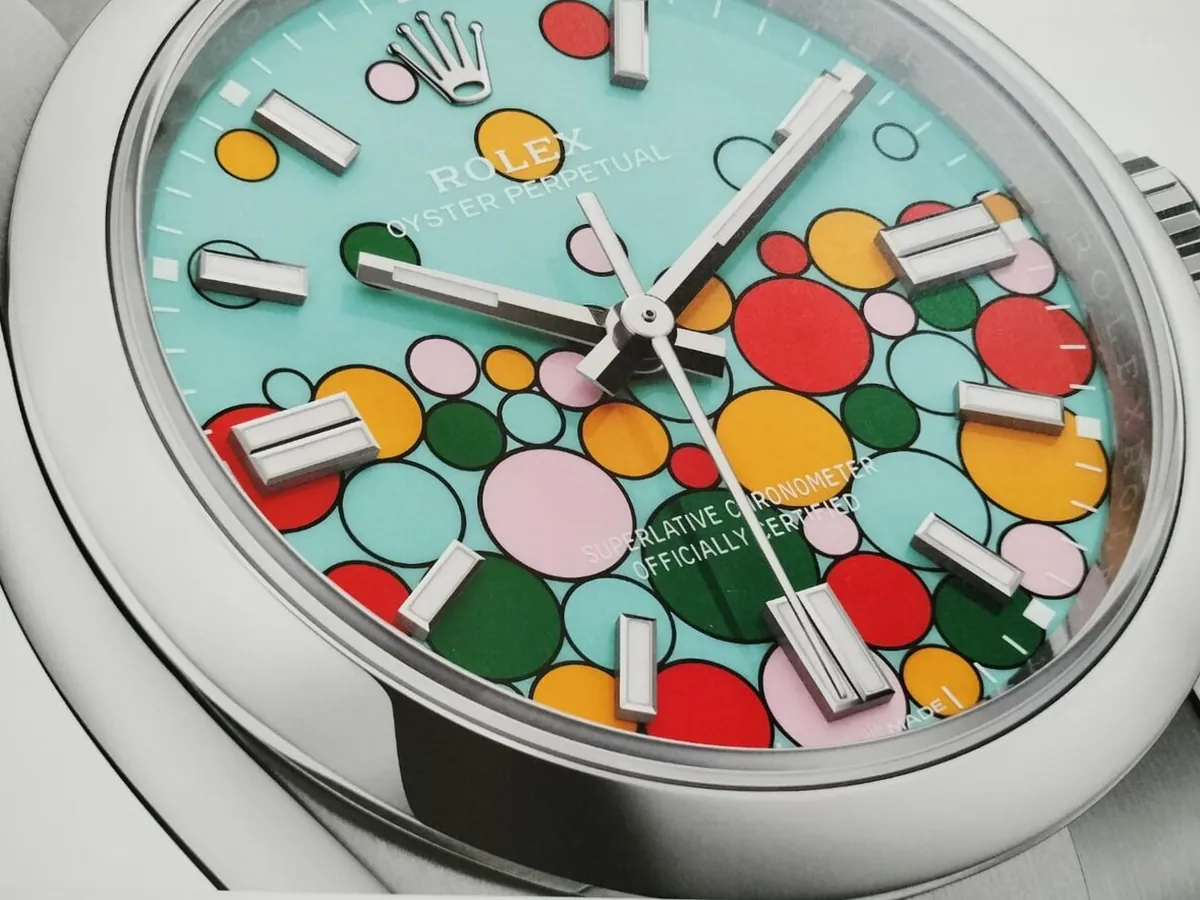
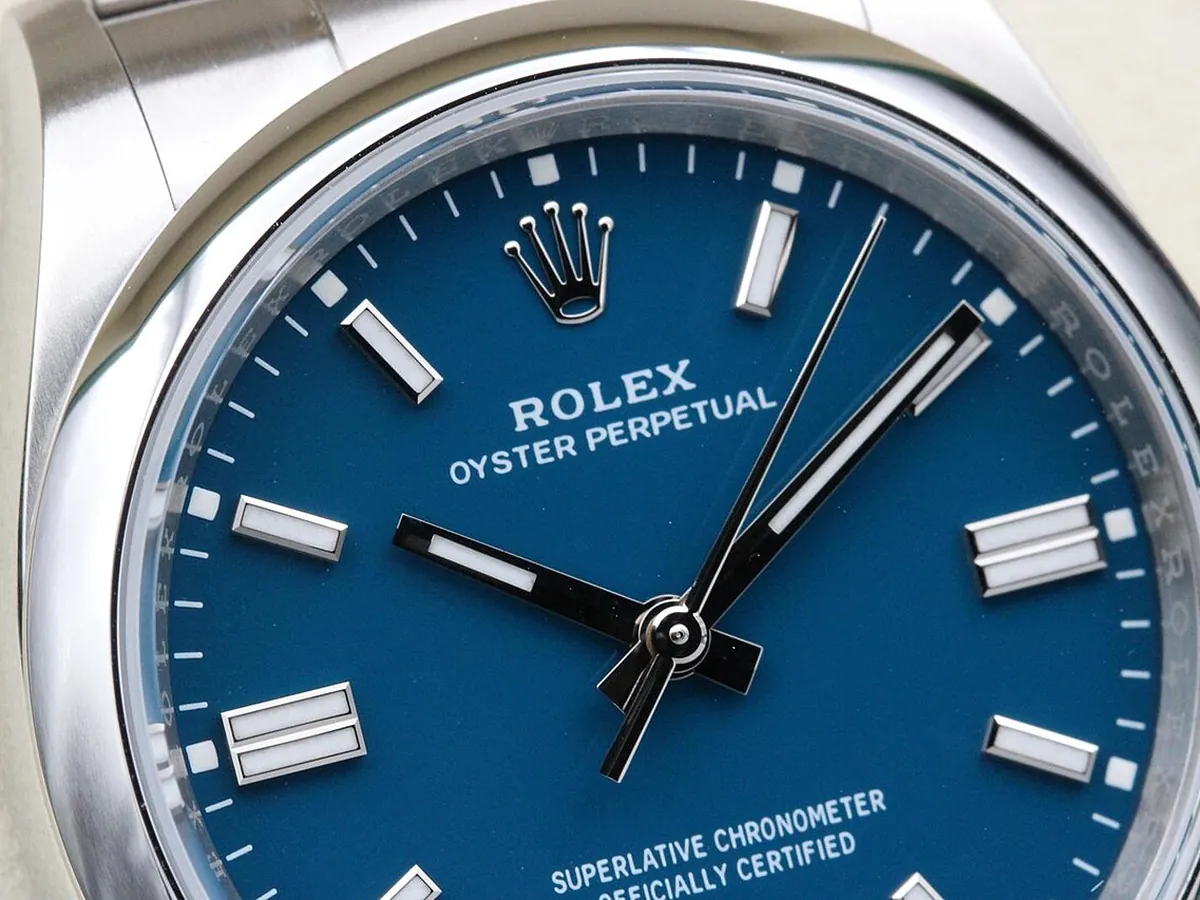
| Dial options | Silver, Bright blue, Bright black, Green, Yellow, Coral red, Turquoise blue, Celebration motif (2023) |
| Crystal | Sapphire, no Cyclops (no date) |
| Calibre | 3230 |
| Movement | Automatic, no date, Superlative Chronometer (-2/+2 s/day), Chronergy escapement, blue Parachrom hairspring, Paraflex shock absorbers |
| Power reserve | 70 hours |
| Water resistance | 100 m |
| Bracelet / strap | Oyster, three-piece links; folding Oysterclasp with 5 mm Easylink extension |
| Retail price (US) | US$6,500 (last list price) |
| US retail in MYR (converted) | ≈ RM26,500 at 4.08; Malaysian list price not published |
Specifications checked against Rolex and independent references, October 2026. MYR figures marked ≈ are converted at 4.08 MYR per USD.
History and reference evolution
Rolex launched the Oyster Perpetual 41 124300 in September 2020, after the cancelled spring fairs. It replaced the 39 mm 114300, so this was the first time the Oyster Perpetual line reached 41 mm. Five years later, at Watches & Wonders 2025, Rolex retired it in favour of the 134300.
From 39 mm to 41 mm
The jump in size was the headline for buyers who had found the old 39 mm watch a little in-between. The extra two millimetres put the OP 41 alongside the Datejust 41 in wrist presence. However, the smooth domed bezel keeps the dial opening wide, so the 124300 can look larger than a Datejust of the same diameter.
Calibre 3230 arrives
Mechanically, the bigger change was inside. The 114300 used calibre 3132 with about 48 hours of reserve. In contrast, the 124300 introduced calibre 3230, a no-date movement with the Chronergy escapement, a blue Parachrom hairspring and roughly 70 hours of reserve. That means a watch taken off on Friday evening should still be running on Monday morning. For value, it also means a 124300 needs no "upgrade" argument against its successor, because both share the same engine.
The colour years
Then came the dials that defined the 124300 Oyster Perpetual. Alongside silver, bright blue, bright black and green, Rolex offered yellow, coral red and turquoise blue lacquer. Those three caused real waiting lists for what had been the easiest steel Rolex to buy. In 2023 the Celebration dial added multicoloured bubbles on a turquoise-blue base. Consequently, an entry-level watch picked up a collector following that its predecessors never had.
Why the 2025 switch matters
The successor dropped yellow, coral, turquoise and Celebration on the 41 mm size. So supply of those dials on a 41 mm OP is now fixed at whatever Rolex made between 2020 and 2025. As a result, the colour dials firmed after the discontinuation, while silver, black and blue examples kept trading near their old level.
124300 pre-owned prices compared
| Condition | What it means | USD | MYR (approx.) |
|---|---|---|---|
| Unworn, full set | Stickers or barely worn, box, card dated within ~2 years, all tags | US$9,500 – US$12,000 | RM39,000 – RM49,000 |
| Excellent, box & papers | Light wear, unpolished or lightly polished, warranty card present | US$8,100 – US$9,900 | RM33,000 – RM40,000 |
| Good, no papers | Normal wear, watch only or box only, service history helps | US$6,900 – US$9,100 | RM28,000 – RM37,000 |
| Polished or aftermarket parts | Soft case edges, replaced dial/bezel/bracelet, or non-Rolex parts | US$5,800 – US$8,400 | RM24,000 – RM34,000 |
Bands reflect asking and achieved prices from 3 public market sources in October 2026, rounded. Retail for comparison: US$6,500. Prices move; use them as a sense-check, not a quote.
Read this table carefully. These bands describe the silver, black and blue dials, which make up most listings. The last US list price was US$6,500, recorded in March 2025. Against that, an excellent core-dial Oyster Perpetual 41 with papers sits around US$8,100 – US$9,900, or roughly RM33,000 to RM40,000.
What moves the price of this reference
On the 124300 Oyster Perpetual, the dial is not one factor among many; it is the factor. The Celebration, turquoise, coral red and yellow dials command large premiums. WatchCharts variation data in 2026 shows the colour dials around US$13,000 to US$20,000. In practice, that means adding roughly 40% to 100% to the bands above. Green sits between the two groups.
After the dial, completeness matters. A full set includes the box, the warranty card, the hang tags and ideally an unsized bracelet. Also check the bezel. Because it is a plain polished dome, any refinishing softens its shape and is easy to see side by side with an untouched example. Bracelet stretch at the clasp end is the other wear point.
Where to check prices
For a discontinued Oyster Perpetual 41, official retail no longer exists. Therefore, the useful sources are dealer asks, marketplace listings and the occasional auction. Search Chrono24 or WatchCharts by the full dial-suffix reference, such as 124300-0007, not by 124300 alone. Otherwise, a turquoise ask will distort a silver-dial comparison. Our used Rolex price guide shows how we weigh each source.
Malaysian private sellers on Mudah or Lowyat often describe colour dials loosely. "Tiffany" usually means turquoise. Ask for the card, which shows the full reference, before you agree on a number.
Service history on a five-year-old watch
The oldest 124300s are now around six years old, so some have already been through a first service. That is not a problem in itself. However, ask what was done. A Rolex service centre may replace hands or polish the case unless the owner asks otherwise, and on a smooth-bezel watch that polishing is easy to spot. Keep the service papers with the set, because they help a future buyer. On the other hand, a recent independent service with no paperwork tells you very little. Our service and value guide explains how each route affects resale.
When a price is too good to be true
Be wary of any complete Oyster Perpetual 124300 set below about US$7,500 (around RM31,000) for a core dial. For a coral, turquoise or Celebration dial, anything under roughly US$10,000 is almost certainly a problem: a fake, a swapped dial or a watch with a history. Also question a card dated after mid-2025, since production ended around then.
Genuine vs replica: how to check a 124300
Replica makers love the Oyster Perpetual 41 124300, because the colour dials earn the highest premiums. Therefore, start with the dial and then work outward. Our real vs fake Rolex guide covers the general checks in more depth.
The lacquer test
Genuine yellow, coral, turquoise and green dials have an even, glossy lacquer. Look for orange-peel texture, dust under the surface or blotchy colour near the markers. The turquoise is the hardest colour to copy; fakes often look too green or too saturated next to Rolex's own photos. On a Celebration dial, every bubble is filled lacquer with a fine black outline. The spacing should be precise all the way round the dial.
Rehaut and crystal
The inner bezel ring is laser-engraved ROLEX ROLEX, with the case serial at 6 o'clock. That number must match the warranty card. In addition, look for the small etched coronet in the crystal at 6 o'clock. It should be barely visible and only at an angle.
Genuine: rehaut engraving alignment
- Each engraved crown and letter lines up with its minute marker
- Engraving is crisp, even in depth, and readable at 12 o'clock
- Serial number engraved on the rehaut at 6 on modern pieces
Warning signs
- Letters drift between markers as they go around the ring
- Shallow, sandy-looking or uneven engraving
- Serial at 6 printed rather than engraved, or wrong format
Genuine: laser-etched crown at 6 o'clock
- Made of tiny dots, hard to find without a loupe
- Sits in the crystal just above the 6 o'clock marker
- Present on most Rolex crystals from the early 2000s onward
Warning signs
- Bold and frosted, easy to spot head-on
- Solid lines instead of a dot matrix
- Off-centre, or placed on a reference/era that would not have it
Case, crown and bracelet
The caseback is plain, screw-down Oystersteel with no window and no factory engraving. The Twinlock crown carries an engraved coronet and should screw down smoothly on crisp threads. Meanwhile, the Oysterclasp carries an engraved coronet and the 5 mm Easylink extension. Its solid end links should meet the case without gaps. Note that the 124300 clasp is thicker than the 134300 one, so a slim clasp here suggests a later bracelet.
Genuine: caseback
- Solid Oystersteel or gold, fluted edge for the case wrench
- No engraving on most models (some are factory-engraved, e.g. Sea-Dweller and Deepsea)
- Display backs are factory-fitted only on certain models (e.g. some Daytona, 1908, Land-Dweller)
Warning signs
- Exhibition window on a model Rolex makes with a solid back
- Stickers or decorative engravings sold as 'factory'
- Back that turns too easily or sits proud of the case
What only a watchmaker can confirm
Only an opened case will confirm calibre 3230, its blue Parachrom hairspring and its Chronergy escapement. A watchmaker can also check that the dial feet and markings are original, which matters most on colour dials. Finally, a timing machine shows whether the rate is close to the -2/+2 seconds a day Rolex certifies.
Who the 124300 suits, and the alternatives
The 124300 Oyster Perpetual is the right watch if you want one of the bright 2020-era dials in the largest size. It is also good value in silver, black or blue for anyone who prefers to buy pre-owned rather than wait for a boutique. For fit, it wears best on wrists from about 17 cm (6.7 in) upward. On smaller wrists the wide dial can look large, which is why many buyers try a 36 mm first.
To weigh that choice, read Oyster Perpetual 36 vs 41 and look at the 126000, which kept a turquoise dial in its catalogue for longer. If you want a date, compare the Datejust 41 126300. For a sportier no-date steel watch, the Explorer 40 is the natural rival. Before you buy any pre-owned example, also read our box and papers guide.
Oyster Perpetual 41 134300
The 2025 OP 41: slimmer lugs, bigger crown, matte pistachio and lavender dials, calibre 3230.
Oyster Perpetual 36 126000
The unisex 36 mm OP with calibre 3230. Turquoise and Celebration dials lead resale.
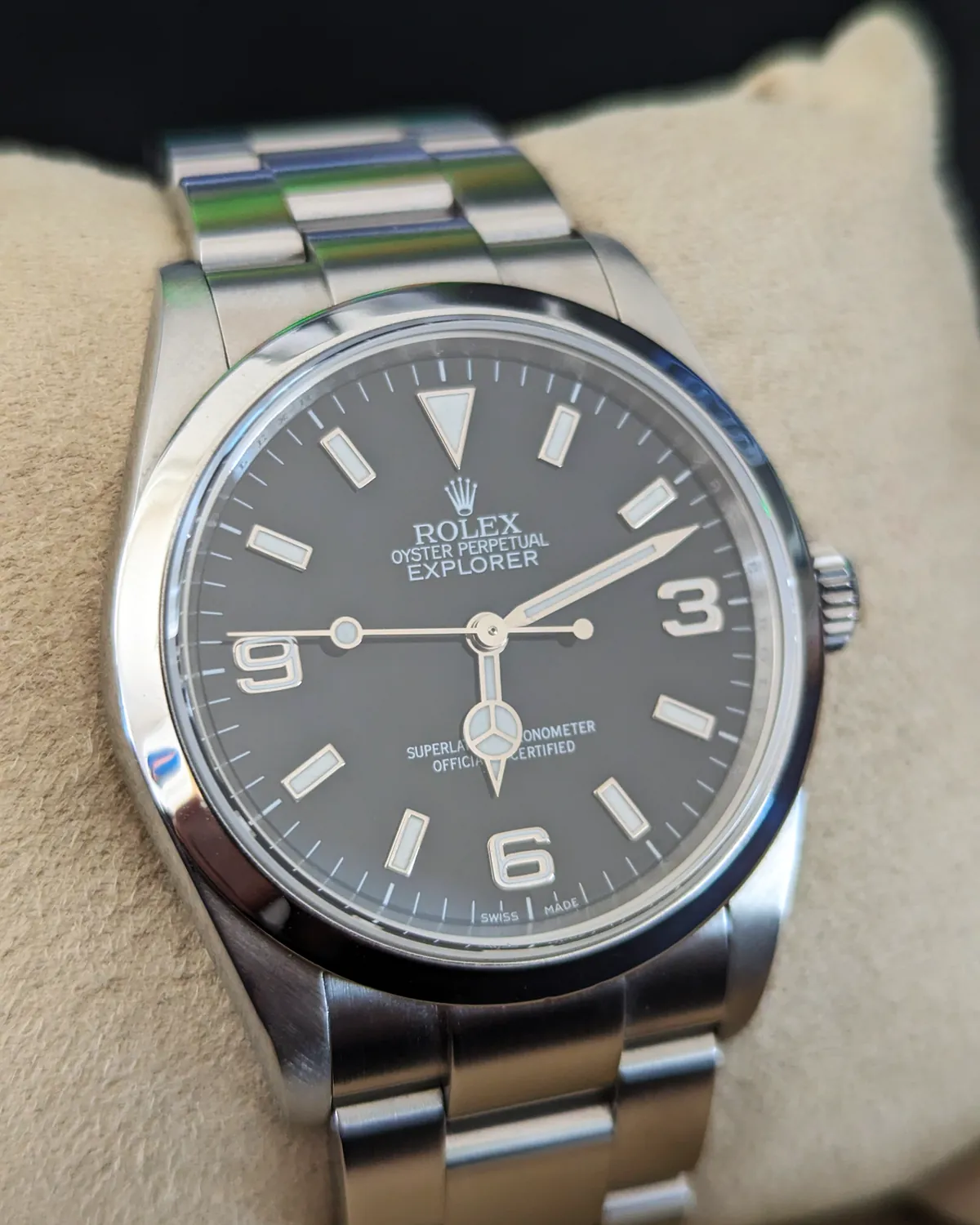
Explorer 40 224270
The 40 mm steel Explorer from 2023. Same calibre 3230 as the 36, for larger wrists.
124300 FAQ
Is the Oyster Perpetual 41 too big?
For most wrists above 17 cm, no. The smooth bezel leaves a wide dial, so it looks bigger than a Datejust 41 on paper and on the wrist. Below about 16.5 cm, try it on first; many buyers there prefer the 36 mm 126000.
Which 124300 dial is the most valuable?
The Celebration dial and turquoise lead, followed by coral red and yellow. All four trade well above the silver, black and blue dials. Green sits in the middle. Always compare asks for the exact dial, not the reference alone.
Why was the 124300 discontinued?
Rolex replaced it with the 134300 at Watches & Wonders 2025. The new model kept calibre 3230 and the 41 mm size but changed the lugs, crown and clasp. It also brought in matte pastel dials and dropped the 2020 colours.
How much is a 124300 in Malaysia?
Core dials with papers trade at roughly RM33,000 to RM40,000 at 4.08 MYR per USD. Colour dials cost much more. Since it is discontinued, official retailers no longer sell it new, so Malaysian buyers rely on dealers and private sales.
Should I buy a 124300 or a 134300?
Buy the 124300 if you want a glossy coral, turquoise, yellow or Celebration dial. Choose the 134300 if you prefer the slimmer case, a pastel matte dial or buying new with a fresh warranty. The movements are the same.
Last updated . Written and fact-checked by the Rolex Malaysian editorial team. Specifications and prices are re-checked quarterly.