Quick answer: Explorer 1 or Explorer 2?
Choose the Explorer 124270 if you want the simplest, most wearable Rolex: 36 mm, time only, no date, and a clean 3-6-9 dial. Choose the Explorer II 226570 if you travel, want a date, and like a bigger, more technical watch. If 36 mm is too small but you prefer the Explorer 1 look, the 40 mm Explorer 224270 is the middle path.
Despite the shared name, these are not a small and large version of one design. The Explorer II has its own history, its own movement and a different purpose. So the comparison is closer to "dress-sport watch vs travel tool watch" than to a size choice.
124270 vs 226570: specifications side by side
The table comes from our reference data. Rolex does not publish thickness, so we add reported figures below it.
| Spec | Explorer 36 124270 | Explorer II 226570 |
|---|---|---|
| Case diameter | 36 mm | 42 mm |
| Case material | Oystersteel | Oystersteel |
| Bezel | Smooth domed, polished | Fixed Oystersteel bezel engraved with 24-hour graduations |
| Dial options | Black lacquer with 3-6-9 Arabic numerals | White ('Polar'), Black |
| Calibre | 3230 | 3285 |
| Power reserve | 70 hours | 70 hours |
| Water resistance | 100 m | 100 m |
| Bracelet / strap | Oyster, three-piece links; Oysterlock safety clasp with Easylink extension | Oyster, three-piece links; Oysterlock safety clasp with Easylink extension |
| Introduced | 2021 | 2021 |
| Status | Current production | Current production |
| Retail price (US) | US$7,900 | US$10,600 |
| Retail price (Malaysia) | RM34,350 | RM46,050 |
| Pre-owned (excellent, box & papers) | US$7,500 – US$8,700 | US$11,000 – US$13,000 |
Reported case thickness is about 11.4 mm for the 124270, 11.6 mm for the 224270 and 12.5 mm for the 226570. Those figures are from independent measurements, not Rolex, so treat them as close approximations.
Two watches, two histories
The Explorer arrived in 1953, the year of the first ascent of Everest, and Rolex built its image on mountaineering. It has always been a 36 mm, time-only watch with a black dial and 3-6-9 numerals. The one exception was the 39 mm 214270 of 2010–2021. Rolex then returned to 36 mm with the 124270 in 2021, and added the 40 mm 224270 in 2023 for larger wrists.
By contrast, the Explorer II began in 1971 with ref. 1655. It added a date, a fixed 24-hour bezel and a large orange 24-hour hand, aimed at cave explorers and polar researchers who could not see daylight. Later versions, such as the 16570 and the 42 mm 216570, made the hour hand independently adjustable. That turned it into a practical travel watch. The current 226570 arrived in 2021 for the model's 50th anniversary.
Design and wearability
Explorer 1: small, flat and versatile
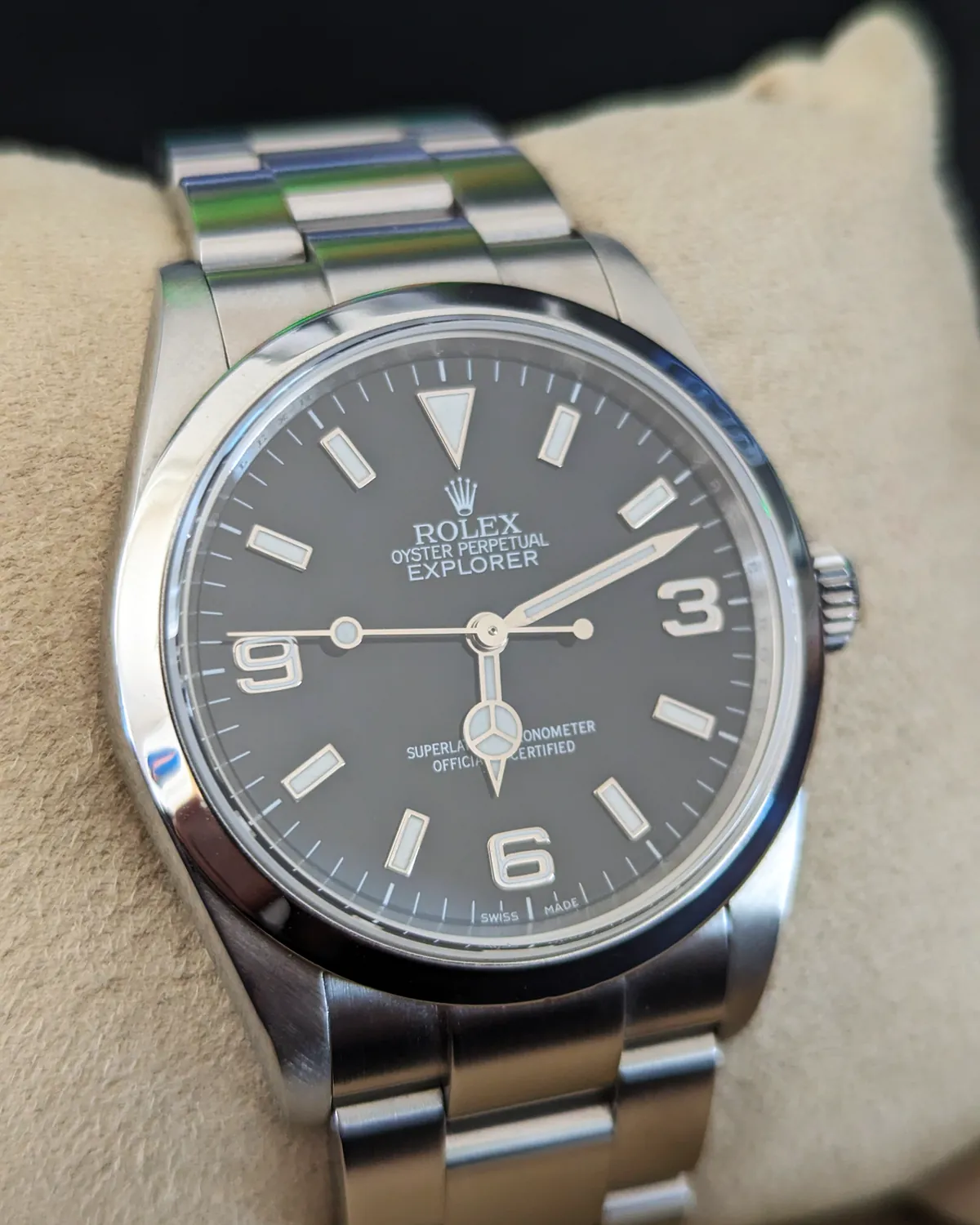
The 124270 has a smooth polished bezel, a gloss black lacquer dial and applied white-gold numerals filled with Chromalight. There are no crown guards and no date, so the case looks clean from every angle. At 36 mm with a short lug-to-lug, it fits wrists from about 15 cm upward and slides under any cuff.
That versatility is the point. In practice, the Explorer 1 works with a suit, a T-shirt or a hiking shirt equally well. However, on wrists above about 18 cm it can look small, which is why the 224270 exists.
Explorer 2: bold, technical, more presence
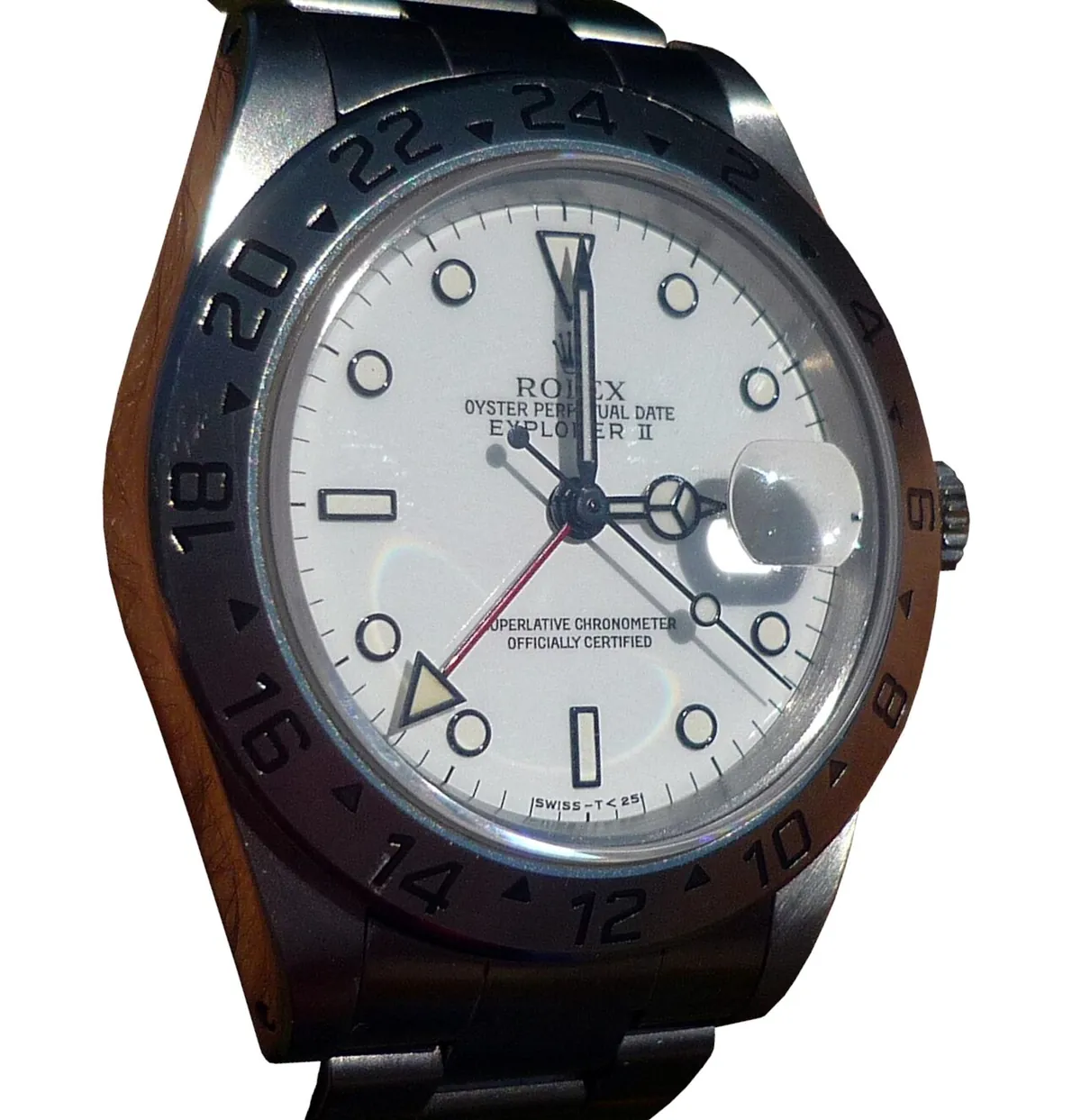
The 226570 is a 42 mm case with crown guards, a broad brushed steel bezel engraved with 24 hours, and a Cyclops over the date. It comes with a white "Polar" dial or a black dial. The bezel is wide, so the dial opening is closer to a 39–40 mm watch than the diameter suggests.
Even so, it wears large. The case is about a millimetre thicker than the Explorer 1, and the lugs are long. As a rough rule, it suits wrists from about 17 cm (6.7 in) upward. On smaller wrists, the lugs tend to overhang. Also, the Polar dial looks bigger than the black dial because white reads larger on the wrist.
Bracelet and clasp
Both use the Oyster bracelet with the Oysterlock safety clasp and a 5 mm Easylink extension. So comfort adjustments are identical. The Explorer II's bracelet is wider, which balances its bigger head but adds weight. For a closer look at clasps, see our Rolex bracelet guide.
Movement and function
The Explorer 124270 and 224270 use calibre 3230: automatic, no date, about 70 hours of reserve, Chronergy escapement and a blue Parachrom hairspring. It is the same movement as the Oyster Perpetual, and it is hard to fault.
The 226570 uses calibre 3285, the same family as the GMT-Master II. It also gives about 70 hours of reserve. In addition, it adds a date and a 24-hour hand. You can jump the hour hand in one-hour steps without stopping the watch, and the date follows forwards or backwards. Therefore, when you land in Kuala Lumpur from London, you reset the local hour and keep home time on the orange hand.
The fixed bezel is the main limit. Unlike the GMT-Master II, you cannot rotate it to track a third zone. Still, for most travellers two zones are enough. Both watches are Superlative Chronometers, rated −2/+2 seconds a day, and both are water resistant to 100 m.
Explorer 1 vs 2 prices: retail and pre-owned
The table covers both Explorer sizes and the Explorer II, with the discontinued predecessors for context.
| Reference | Retail | Unworn, full set | Excellent, B&P | Good, no papers | Mid-band vs retail |
|---|---|---|---|---|---|
| Explorer 36 124270 | US$7,900 | US$8,600 – US$9,700 | US$7,500 – US$8,700 | US$6,400 – US$8,000 | +3% |
| Explorer 40 224270 | US$8,350 | US$9,200 – US$10,500 | US$8,200 – US$9,300 | US$7,000 – US$8,600 | +5% |
| Explorer II 226570 | US$10,600 | US$12,500 – US$14,000 | US$11,000 – US$13,000 | US$9,400 – US$12,000 | +13% |
| Explorer 39 214270 | US$6,550 | US$8,500 – US$10,000 | US$7,000 – US$8,500 | US$6,000 – US$7,800 | +18% |
| Explorer II 216570 | US$8,350 | US$10,000 – US$11,500 | US$8,400 – US$10,300 | US$7,100 – US$9,500 | +12% |
Retail is the current (or last) US list price. Pre-owned bands are rounded market ranges for October 2026; MYR ≈ USD × 4.08.
Retail and the Malaysian list
At retail, the 124270 lists at US$7,900 and the 226570 at US$10,600, a gap of US$2,700. In Malaysia, authorised dealers list them at RM34,350 and RM46,050, with the 224270 at RM36,250. All three are among the easier Rolex models to buy at an AD in 2026, so there is little reason to pay a grey-market premium for a new one.
Pre-owned value
An excellent Explorer 124270 with papers trades around US$7,500 – US$8,700, roughly at retail. By contrast, the Explorer II trades around US$11,000 – US$13,000, a modest premium led by the Polar dial. The Polar typically asks US$500–1,500 more than black. In short, neither is a speculative watch; both are good-value ways into a current-calibre Rolex.
Older references offer savings. The 39 mm 214270 trades around US$7,000 – US$8,500 and the 216570 around US$8,400 – US$10,300. However, both use older 48-hour calibres, so budget for a service. Our used Rolex price guide explains how condition and papers move these bands.
Ownership, servicing and resale
Servicing
Both modern calibres share Rolex's ten-year service guidance and the five-year warranty. A GMT movement has more parts, so an Explorer II service can cost a little more at an independent watchmaker. At a Rolex service centre, pricing is usually similar for steel models. See our Rolex service guide for current costs.
What to check when buying used
On the Explorer 1, the polished smooth bezel and lugs show polishing quickly. On the Explorer 2, check that the bezel engraving is still sharp and the 24-hour hand aligns with the hour hand at each hour. On both, match the rehaut serial to the warranty card. Our real vs fake Rolex guide covers each step, and the box and papers guide explains why the card matters.
Resale over time
Both models have been steady rather than spectacular. The Explorer II has historically been one of Rolex's more undervalued steel sports watches, and premiums faded as AD supply improved. So buy whichever you will wear; the resale difference after a few years is likely to be modest.
Which Explorer should you buy?
Choose the Explorer (124270 or 224270) if…
- you want one Rolex for every occasion, including formal wear;
- you prefer no date and a perfectly symmetrical dial;
- your wrist is under about 17 cm (124270) or you want 40 mm (224270);
- you want the lowest entry price, from US$7,900.
Choose the Explorer II 226570 if…
- you travel and want a second time zone and a date;
- you like a bigger, sportier watch with crown guards;
- you want a white dial, which few Rolex sports models offer;
- your wrist is about 17 cm (6.7 in) or larger.
Still undecided? The Air-King vs Explorer page compares the 224270 with another 40 mm option, and our first Rolex buying guide sets both against the Oyster Perpetual and Submariner. The Explorer collection page lists every reference, including the two-tone 124273.
Verdict
The Explorer 1 is the purer watch: smaller, simpler and cheaper, and ideal as a single daily Rolex. The Explorer 2 is the better tool if you travel or want a date. If your wrist is large and you want simplicity, the 40 mm 224270 resolves the size issue without the GMT. Buy new at retail if you can, since neither carries a meaningful pre-owned premium.
Explorer 1 vs 2 FAQ
Is the Explorer II bigger than the Explorer?
Yes, clearly. The Explorer II 226570 is 42 mm across and about 12.5 mm thick, against 36 mm and about 11.4 mm for the Explorer 124270. It also has crown guards and a wide engraved bezel, so it wears larger than the 6 mm gap suggests. The 40 mm Explorer 224270 sits between them.
Is the Explorer II a GMT watch?
Yes. The 226570's calibre 3285 has an independently adjustable hour hand that jumps in one-hour steps, plus an orange 24-hour hand that reads against the fixed bezel. That lets you track two time zones. Unlike a GMT-Master II, the bezel does not rotate, so a third zone is not possible.
Is the Explorer 36 too small for men?
Not for most wrists. The 124270 matches the original 1953 Explorer size and looks right on wrists up to about 17.5 cm (6.9 in). On larger wrists it reads as a deliberately vintage choice. If 36 mm feels small, the 40 mm 224270 has the same dial and calibre for US$450 more at list.
Which holds value better, Explorer or Explorer II?
In October 2026 the Explorer II does slightly better. Excellent 226570s with papers trade around US$11,000–13,000 against a US$10,600 list, with the white Polar dial at the top. The 124270 trades around US$7,500–8,700 against US$7,900. Neither is a strong store of value; buy either to wear.
Why does the Explorer II have an orange hand?
The orange 24-hour hand dates back to the first Explorer II, ref. 1655 of 1971. It was designed to tell day from night in places without daylight, such as caves or polar winters. Rolex brought back an oversized orange hand on the 216570 in 2011 and kept it on the 226570.
Last updated . Written and fact-checked by the Rolex Malaysian editorial team. Specifications and prices are re-checked quarterly.