Quick answer
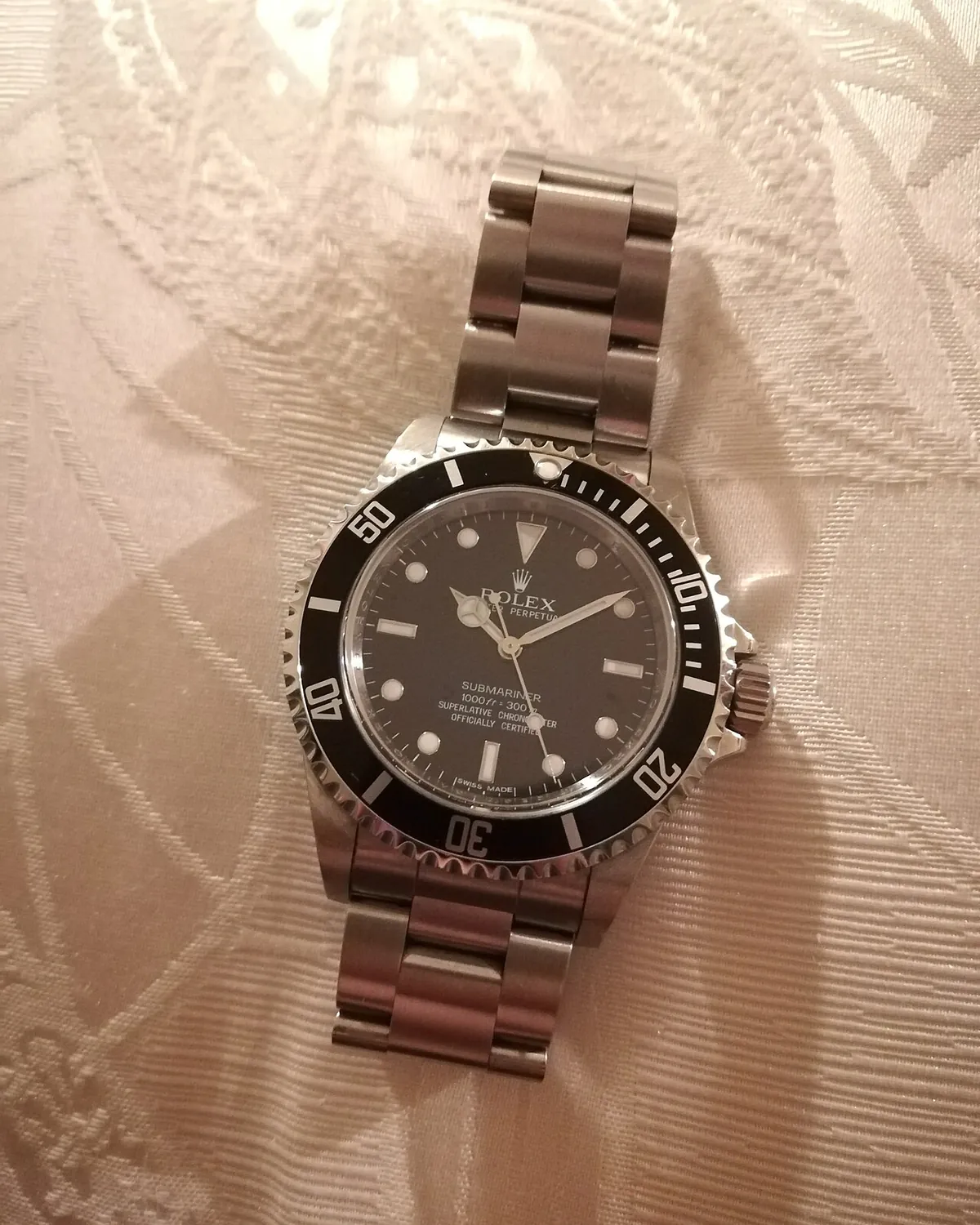
Choose a 5-digit Submariner 16610 if you want a slimmer, lighter watch with an aluminium bezel that ages, and you accept neo-vintage risks. Choose a 6-digit Submariner 116610LN if you want ceramic, a solid bracelet with Glidelock and near-modern durability. The current 126610LN is the 6-digit model refined, at a higher price.
We are independent and do not sell watches. Prices are October 2026 dealer and marketplace levels, converted at 4.08 MYR per USD.
5 digit vs 6 digit Submariner specifications
The table compares the last 5-digit Submariner Date with the first ceramic 6-digit one. Rolex no longer lists either, so retail cells are blank.
| Spec | Submariner Date 16610 | Submariner Date 116610LN |
|---|---|---|
| Case diameter | 40 mm | 40 mm |
| Case thickness | — | 12.5 mm |
| Case material | Stainless steel (904L) | Stainless steel (904L) |
| Bezel | Unidirectional rotatable 60-minute graduated, black aluminium insert (green on 16610LV) with luminous pip | Unidirectional rotatable 60-minute graduated, black Cerachrom insert, platinum-coated numerals |
| Dial options | Black, Black with green bezel (16610LV 'Kermit') | Black (Maxi markers, Chromalight) |
| Calibre | 3135 | 3135 |
| Power reserve | 48 hours | 48 hours |
| Water resistance | 300 m | 300 m |
| Bracelet / strap | Oyster 93150 with Fliplock diver extension clasp; hollow end links on early examples, solid end links on later ones | Oyster with solid links and end links; Oysterlock clasp with Rolex Glidelock extension |
| Introduced | 1988 | 2010 |
| Status | Discontinued (2010) | Discontinued (2020) |
| Pre-owned (excellent, box & papers) | US$10,500 – US$12,800 | US$12,200 – US$14,300 |
Note that both use calibre 3135 and both are 40 mm. The change in 2010 was therefore about the case, bezel, dial and bracelet. The movement upgrade came later, with the 126610LN's calibre 3235 in 2020.
Design and wearability
Case and lugs
The 16610 has the slim, tapering lugs and narrow crown guards that Submariners wore for decades. Viewed from above it looks delicate, and it sits flat on smaller wrists. Cases made before roughly 2003 also have drilled lug holes, which make strap changes easy.
The 116610LN introduced the "Maxi" case. Its lugs are broad and flat-topped, and its crown guards are thick. Consequently, it looks much heavier for the same 40 mm diameter. Some people love the muscular stance; others found it chunky, which is one reason Rolex slimmed the lugs again on the 126610LN.
| Measurement | 16610 (1988–2010) | 116610LN (2010–2020) | 126610LN (2020–) |
|---|---|---|---|
| Diameter | 40 mm | 40 mm | 41 mm |
| Thickness | about 12.5–13 mm | 12.5 mm | 12.5 mm |
| Lug to lug | about 48 mm | about 48 mm | about 48 mm |
| Lug width | 20 mm | 20 mm | 21 mm |
| Lugs | Slim, tapering; holes to about 2003 | Broad "Maxi", solid | Slimmer again, solid |
| Bezel insert | Aluminium | Cerachrom ceramic | Cerachrom ceramic |
| Clasp | Stamped Fliplock | Glidelock | Glidelock |
In practice, the 16610 suits wrists from about 15.5 cm (6.1 in), the 116610LN from about 16.5 cm (6.5 in). The 126610LN sits between them visually, despite being 41 mm.
Bezel: aluminium vs ceramic
This is, above all, the change most buyers notice. The 16610's aluminium insert is matte and slightly glossy at the edges. However, over the years it scratches, and it can fade from black towards grey. Many collectors prize a gently faded insert, but it also means condition varies widely.
The 116610LN's Cerachrom insert is glossy black ceramic with platinum-coated numerals. As a result, it resists scratches and does not fade in sunlight or chlorinated water. However, a hard knock can chip it, and a chipped insert has to be replaced. Our Rolex materials guide explains Cerachrom in detail.
Dial and lume
The 16610's dial has small, round hour markers and a slim Mercedes hand. Early dials use tritium, marked "SWISS – T < 25" at 6. Around 1998–2000 Rolex switched to LumiNova and then Super-LumiNova, marked "SWISS MADE". Typically, tritium dials develop a cream patina; luminescent paint dials stay white and still glow.
The 116610LN has "Maxi" markers and broader hands, with Chromalight lume that glows blue and lasts longer through the night. It also has the engraved "ROLEX" rehaut with the serial at 6. By contrast, only late 16610s, made from around 2007, have the engraved rehaut.
Bracelet and clasp
The 16610's Oyster bracelet has hollow end links on early examples and a stamped Fliplock clasp with a diver's extension. It is light and comfortable, but it also rattles and stretches with age. The 116610LN's bracelet uses solid links, solid end links and the Glidelock clasp. Glidelock adjusts in roughly 2 mm steps for about 20 mm in total, without tools. For daily wear in a tropical climate, that is a real improvement. See our bracelet and clasp guide.
Movement: the same calibre 3135
Both generations run calibre 3135, an automatic COSC chronometer with a 48-hour reserve and quickset date. It is one of Rolex's most durable movements, and every competent watchmaker knows it well.
That said, there is one meaningful difference. Early 16610s use a traditional hairspring with a Breguet overcoil. The 116610LN uses Rolex's blue Parachrom hairspring, which resists magnetism and shocks better. Some late 16610s also received Parachrom springs at service.
The 126610LN's calibre 3235 moved things forward: 70 hours of reserve, the Chronergy escapement and Superlative Chronometer accuracy of −2/+2 seconds a day. Therefore the biggest movement jump is from 6-digit to current, not from 5-digit to 6-digit.
Price comparison: 5-digit, 6-digit and current
| Reference | Retail | Unworn, full set | Excellent, B&P | Good, no papers | Mid-band vs retail |
|---|---|---|---|---|---|
| Submariner Date 16610 | n/a | US$13,000 – US$15,500 | US$10,500 – US$12,800 | US$8,800 – US$10,500 | — |
| Submariner Date 116610LN | n/a | US$14,000 – US$15,500 | US$12,200 – US$14,300 | US$11,000 – US$12,200 | — |
| Submariner Date 126610LN | US$11,350 | US$15,500 – US$16,900 | US$14,000 – US$15,600 | US$12,300 – US$13,700 | +30% |
Retail is the current (or last) US list price. Pre-owned bands are rounded market ranges for October 2026; MYR ≈ USD × 4.08.
What you get for the money
An excellent 16610 with box and papers sits at US$10,500 – US$12,800, about RM42,850–52,200. An excellent 116610LN sits at US$12,200 – US$14,300, about RM49,800–58,350. So the ceramic generation costs roughly $1,700 more on average. A current 126610LN at US$14,000 – US$15,600 adds about another $1,500.
Within the 5-digit market, however, prices spread widely. Full sets with tritium dials and matching patina command collector premiums. Similarly, late examples with the engraved rehaut ask more. On the other hand, watches with service dials, hands or inserts are worth noticeably less to collectors. The green-bezel 16610LV "Kermit" is a separate, pricier variant.
For 6-digit models, value hinges on completeness and polishing. The broad Maxi lugs show polishing clearly, so an unpolished case is worth a premium. Equally, the green 116610LV "Hulk" trades far above the black at US$19,500 – US$22,500.
Checklist before buying an older Submariner
Both generations are now pre-owned only, so the watch's history matters as much as the reference. Work through these steps in order before agreeing a price.
- Read the reference between the lugs at 12 and the serial at 6 (or on the rehaut for engraved-rehaut cases). Then match both to the papers.
- Date the serial with our serial number guide, and check that dial lume, crystal etch and lug holes fit that year.
- Inspect the lugs side-on. Sharp bevels between the brushed tops and polished sides mean an unpolished case; rounded edges mean heavy polishing.
- Turn the bezel through a full revolution. It should click 120 times, anticlockwise only, without slack. On a 116610LN, look for chips at the insert's edge.
- Hold the bracelet horizontally by one end. Severe sag on a 16610 signals stretch, and missing links reduce value on either generation.
- Ask for service paperwork, and whether the dial, hands and insert are original or service parts.
- Have a watchmaker open the caseback and confirm a genuine calibre 3135 before final payment.
Each step takes a few minutes, yet together they catch most problems on a 5-digit or 6-digit Submariner. For box-and-papers questions, see Rolex box and papers.
Ownership, servicing and resale
Servicing a 5-digit
The 3135 is easy to service, and parts remain available. The catch, however, is cosmetic. Rolex service centres have historically replaced tritium dials, hands and faded inserts with new parts, which lowers collector value. If originality matters, ask for old parts back, or use an independent watchmaker you trust. Our service and value guide covers this trade-off.
Servicing a 6-digit
A 116610LN is now between six and sixteen years old, so many are due a first or second service. Usually the work is routine, and the Parachrom hairspring helps keep timing stable. Budget for it when buying a watch without recent service paperwork.
Resale
In short, both trade in steady markets. The 16610 has become a neo-vintage collectible with a stable price, while the 116610LN is the sensible value option below the current watch. Neither has the liquidity of a 126610LN, but both sell readily with papers. See the used Rolex price guide for broader market data.
Which generation should you buy?
Choose a 5-digit 16610 if…
- you prefer slim lugs and a lighter, flatter watch
- you like an aluminium insert that ages with you
- you have a smaller wrist
- you enjoy hunting for original dials and correct details
- you want the lowest entry price to a Submariner Date
Choose a 6-digit 116610LN if…
- you want a scratch-resistant ceramic bezel
- you value a solid bracelet with Glidelock adjustment
- you like the bold Maxi case and dial
- you want modern durability without the current-model price
- you would rather avoid neo-vintage originality questions
Verdict
The 116610LN is the safer purchase: tougher materials, a better bracelet and fewer originality traps. The 16610 is the more characterful one, and for many enthusiasts the more elegant shape. If you can stretch, the 126610LN combines the slimmer look with a modern movement. Buy a 5-digit for charm and a 6-digit for practicality, and inspect either carefully before paying.
More comparisons: Submariner Date vs No-Date, new vs used Submariner, and the full Submariner collection.
5-digit vs 6-digit Submariner FAQ
Are 5-digit Submariners a good buy?
Yes, if you buy the right one. A 16610 with original parts, a sharp unpolished case and papers is a robust neo-vintage watch at US$10,500 – US$12,800. The risks are service-replaced parts, heavy polishing and mismatched dials. Pay for an inspection, and expect older bracelets and aluminium inserts to show their age.
What is the difference between 16610 and 116610?
The 116610LN of 2010 replaced the 16610's aluminium bezel insert with Cerachrom ceramic, the slim lugs with a broad 'Maxi' case, and the stamped Fliplock bracelet with solid links and the Glidelock clasp. It added Chromalight lume and an engraved rehaut. Both use calibre 3135 and a 40 mm case.
What does 5-digit and 6-digit mean on a Rolex?
It counts the digits in the reference number. Five-digit references, such as 16610 or 14060, were produced from the late 1980s to about 2010. Six-digit references, such as 116610LN or 126610LN, mark the modern generation. The extra leading '1' signalled the new platform. Our reference number decoder explains the system.
Is a ceramic bezel better than aluminium?
For durability, yes. Cerachrom is extremely scratch-resistant and its colour does not fade in sunlight or seawater. Aluminium inserts scratch and fade, but many collectors like that patina. On the other hand, a chipped ceramic insert must be replaced, while a scratched aluminium one can simply be lived with.
Is the 116610LN worth buying over the 126610LN?
It can be, as a value play. A good 116610LN with papers sits at US$12,200 – US$14,300, roughly $1,500–2,000 below a 126610LN. In return you give up 22 hours of power reserve and the slimmer 2020 lugs. If you prefer the bolder Maxi look, it is a sensible saving.
Last updated . Written and fact-checked by the Rolex Malaysian editorial team. Specifications and prices are re-checked quarterly.