Submariner 16610 specifications
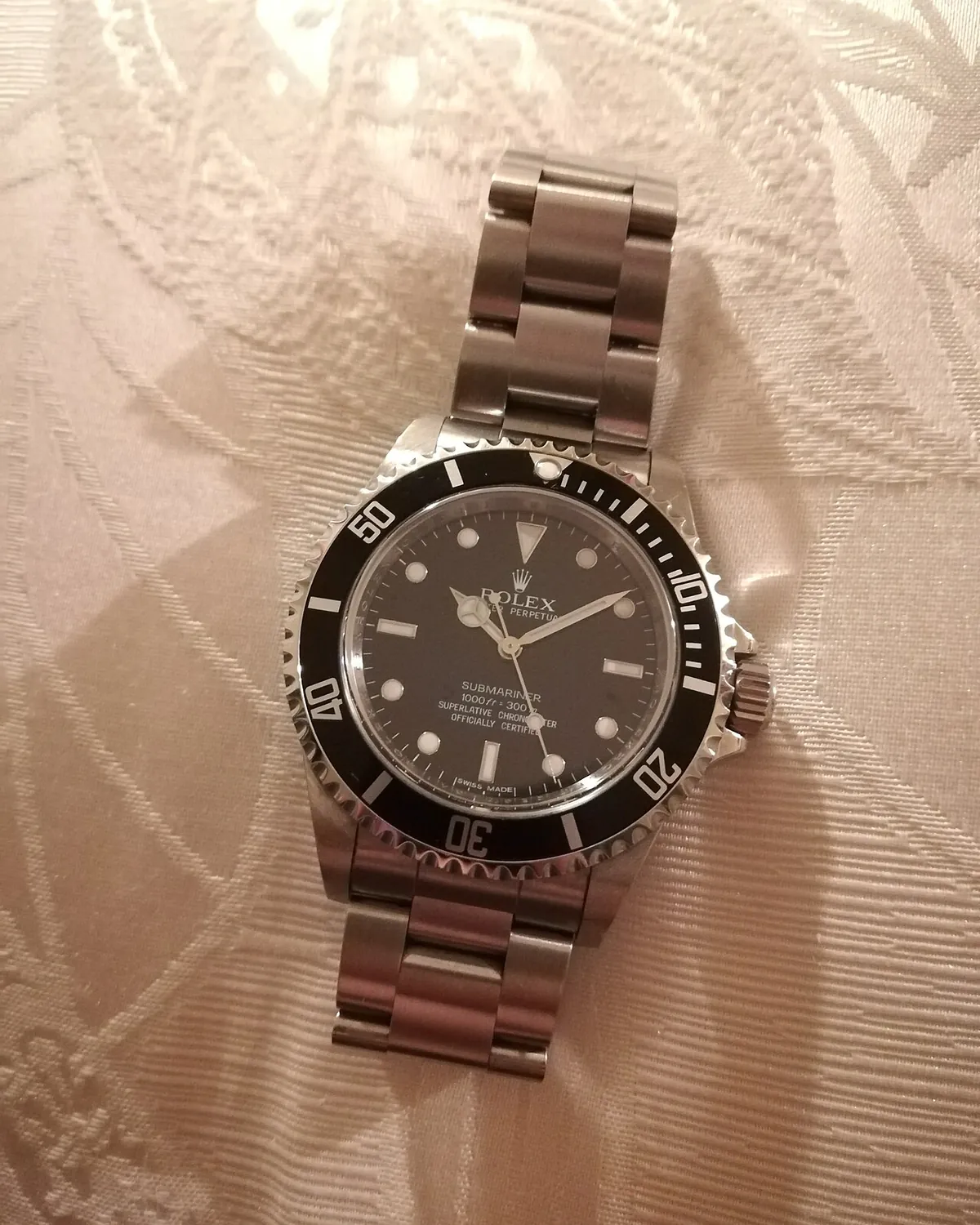
On paper the Submariner 16610 looks close to its successor. In practice, the slim case, aluminium insert and 48-hour calibre 3135 make it a lighter, flatter and more old-fashioned watch on the wrist.
| Reference | 16610 (also 16610LV) |
|---|---|
| Collection | Submariner |
| Status | Discontinued (2010) |
| Introduced | 1988 |
| Predecessor | 16800 |
| Successor | 116610LN |
| Case diameter | 40 mm |
| Case material | Stainless steel (904L) |
| Bezel | Unidirectional rotatable 60-minute graduated, black aluminium insert (green on 16610LV) with luminous pip |
| Dial options | Black, Black with green bezel (16610LV 'Kermit') |
| Crystal | Sapphire, Cyclops lens over the date; laser-etched crown at 6 from about 2002 |
| Calibre | 3135 |
| Movement | Automatic, COSC chronometer, free-sprung Microstella balance with Breguet overcoil, quickset date |
| Power reserve | 48 hours |
| Water resistance | 300 m |
| Bracelet / strap | Oyster 93150 with Fliplock diver extension clasp; hollow end links on early examples, solid end links on later ones |
Specifications checked against Rolex and independent references, October 2026. MYR figures marked ≈ are converted at 4.08 MYR per USD.
History and reference evolution
The Rolex Submariner 16610 arrived in 1988 (some sources say 1989) to replace the 16800 and the short-lived 168000. It kept their sapphire crystal and 40 mm case. However, it introduced the calibre 3135, which went on to power Submariner Dates until 2020. Rolex then built the reference with only incremental changes for 22 years. As a result, a 1989 watch and a 2009 watch share a reference number but differ in lume, bracelet, case drilling, crystal and rehaut. Those small details now decide price more than condition alone. The background on earlier Submariners is summarised on Wikipedia's Submariner entry.
Year-by-year transitions at a glance
The table below is a working map, not a factory record. Rolex changed parts as stocks ran out, so the boundaries overlap by a year or more.
| Era | Serial prefixes | Key details | Effect on price |
|---|---|---|---|
| About 1988–1997 | R, L, E, X, N, C, S, W, T | Tritium dial marked 'SWISS – T < 25', drilled lug holes, hollow end links | Small premium if lume is original and matched |
| About 1998–1999 | U, A | Transitional 'SWISS' only dial with LumiNova | Niche interest; originality decides it |
| About 2000–2003 | P, K, Y | 'SWISS MADE' Super-LumiNova dial, solid end links, crystal crown etch from about 2002 | Core market band |
| About 2003–2007 | F, D, Z | Solid lugs without holes | Core market band |
| About 2007–2010 | Late Z, M, V, G | Engraved 'ROLEX' rehaut with serial at 6 | Top of the steel band |
Tritium, then LumiNova, then Super-LumiNova
Until about 1998, the 16610 used tritium paint. The dial reads 'SWISS – T < 25' at 6 o'clock, and the plots have usually aged to cream or pale yellow. Tritium no longer glows after about 25 years. So a bright green glow from a tritium-marked dial means relumed plots, replaced hands or a fake.
Around 1998, Rolex switched to non-radioactive LumiNova. For a short spell, dials simply read 'SWISS' at 6. Collectors call these transitional dials, and they are the rarest of the standard black versions. By about 2000, the text became 'SWISS MADE' and the paint became Super-LumiNova. In value terms, the tritium and transitional dials reward originality. Meanwhile, the Super-LumiNova watches are priced mostly on condition and paperwork.
End links, lug holes and the crown etch
The bracelet changed next. Early 16610s wore the Oyster 93150 with hollow end links, which feel tinny. Solid end links arrived around 2000, and the clasp kept its Fliplock diver extension throughout. Then, from about 2003, Rolex stopped drilling the lugs. Solid lugs look cleaner, yet many buyers prefer lug holes because straps change in seconds. As a result, neither version carries a clear premium today.
Around 2002, Rolex also began laser-etching a tiny coronet into the crystal at 6 o'clock. This matters for authentication more than price. A 1993 serial with an etched crystal simply had its crystal replaced at service.
The engraved rehaut and the last serials
From about 2007, Rolex engraved 'ROLEX' around the inner bezel ring, with the serial at 6 o'clock. These late Z, M and V serial watches feel closest to a modern Rolex. Consequently, they sit at the top of the steel band, especially with papers. A few final pieces carry G serials from 2010, just before Rolex moved to random serials.
The Kermit sideline and the 2010 successor
In 2003, Rolex added the 16610LV with a green aluminium bezel. It is the same case and movement, but it is valued far higher, so check it on its own evidence. In 2010, the ceramic-bezel Submariner 116610LN replaced the 16610 with a broader case, Cerachrom insert and Glidelock clasp. Our 5-digit vs 6-digit Submariner comparison sets the two generations side by side.
16610 pre-owned prices compared
| Condition | What it means | USD | MYR (approx.) |
|---|---|---|---|
| Unworn, full set | Stickers or barely worn, box, card dated within ~2 years, all tags | US$13,000 – US$15,500 | RM53,000 – RM63,000 |
| Excellent, box & papers | Light wear, unpolished or lightly polished, warranty card present | US$10,500 – US$12,800 | RM43,000 – RM52,000 |
| Good, no papers | Normal wear, watch only or box only, service history helps | US$8,800 – US$10,500 | RM36,000 – RM43,000 |
| Polished or aftermarket parts | Soft case edges, replaced dial/bezel/bracelet, or non-Rolex parts | US$7,500 – US$8,800 | RM31,000 – RM36,000 |
Bands reflect asking and achieved prices from 2 public market sources in October 2026, rounded. Retail for comparison: n/a. Prices move; use them as a sense-check, not a quote.
Rolex no longer sells the 16610, and we could not confirm its last US list price from two reliable sources. So the useful benchmark is the market itself. At 4.08 ringgit per dollar, an excellent example with papers works out at about RM43,000 to RM52,000. A good Submariner 16610 without papers converts to roughly RM36,000 to RM43,000.
What moves the price of this reference
First comes dial generation. A matched tritium dial or a transitional 'SWISS' dial earns more than a 2004 Super-LumiNova dial in the same condition. Second, original parts matter. Rolex service centres routinely fitted new dials, hands and bezel inserts. Those parts are genuine, but they turn a collectable 1995 watch into an ordinary one.
Third, the late engraved-rehaut watches, from about 2007, add a few hundred to a thousand dollars when papers come with them. Fourth, case condition counts more than on later Submariners. The thin lugs show polishing quickly, and sharp bevels are hard to fake back. Finally, the original guarantee paper with a matching serial lifts any 16610 by roughly the gap between the papers and no-papers bands. Our box and papers guide explains what a complete set looks like for this era.
Where to check prices
There is no authorised dealer price to anchor against, so use three sources together. Chrono24 asking prices show the ceiling, and most 16610s sell below ask. Large dealers such as Bob's Watches publish prices for named serial eras, which helps you compare like with like. Auction results are useful mainly for tritium watches with original boxes, because ordinary examples rarely go to the major houses.
In Malaysia, listings on Mudah and the Lowyat watch forum often omit the serial letter. Ask for it before discussing price, because a T serial and a V serial are different propositions. Dealers in Singapore and Hong Kong often hold more stock, although you should check what Malaysian customs will charge when you bring one home. Our used Rolex price guide explains how we compile the bands.
When a price is too good to be true
The polished or aftermarket band starts around US$7,500 (about RM31,000). Therefore, treat any 16610 offered as all-original with papers below about US$8,500 with suspicion. Common explanations include a fake, a watch with aftermarket parts, or a stolen piece. Equally, be wary of 'unworn' claims on 1990s watches. Genuine new-old-stock 16610s exist, but most are late V or G serials.
Genuine vs replica: how to check a Submariner 16610
The 16610 has been copied for decades, and the best modern replicas now use cloned 3135-style movements. Still, the reference has a strong advantage for buyers: its details changed by year. So a fake, or a watch assembled from mixed parts, often shows features that cannot coexist on one serial.
Match every detail to the serial
Start with the serial between the lugs at 6 o'clock, then check the reference at 12. Next, compare the dial text, lume colour, lug holes, crystal etch and rehaut against the era table above. For example, an engraved rehaut on an early serial points to a fake or a case swap. By contrast, a plain rehaut is correct on almost all 16610s. A crystal crown on a pre-2002 serial is usually just a replacement crystal.
Genuine: laser-etched crown at 6 o'clock
- Made of tiny dots, hard to find without a loupe
- Sits in the crystal just above the 6 o'clock marker
- Present on most Rolex crystals from the early 2000s onward
Warning signs
- Bold and frosted, easy to spot head-on
- Solid lines instead of a dot matrix
- Off-centre, or placed on a reference/era that would not have it
Lume, bezel and Cyclops
On tritium watches, the plots and hand lume should have aged together. Uneven tones mean something was replaced. The aluminium insert should show honest fading and fine scratches, and a ceramic insert on a 16610 is always aftermarket. Also, the bezel should turn one way only through 120 firm clicks without play. Under the Cyclops, the date numeral should swell to fill the lens, an enlargement of about 2.5x.
Genuine: cyclops magnification
- Date fills the lens edge to edge
- Numerals stay sharp right to the lens rim
- Lens sits centred over the date window
Warning signs
- Date looks small, with a visible margin
- Lens slightly off-centre or bubbled
- Strong blue anti-glare tint on top of the lens
Bracelet and clasp
Turn the bracelet over. The clasp carries a date code that should roughly match the case era. Fliplock clasps on fakes often show soft stamping and rough edges inside the blade. However, original bracelets were swapped at service, so a mismatch alone proves little.
Genuine: clasp and bracelet machining
- Crisp transitions between brushed and polished surfaces
- Clasp blade and logo cleanly milled, not stamped-looking
- Bracelet links tight, quiet, no rattle; screws not pins on modern pieces
Warning signs
- Polishing bleeds over brushed edges
- Fuzzy logo, uneven font, or stamped-in look
- Loose links, sharp burrs inside the clasp, cheap spring-loaded feel
What only a watchmaker can confirm
On a Submariner 16610, only an opened caseback settles the question. A watchmaker will check for a genuine calibre 3135 with a Microstella balance, Breguet overcoil and red reversing wheels. They will also look for reference and calibre markings and non-Rolex parts. In addition, they can pressure-test the case. That matters in Malaysia's humidity, because 30-year-old gaskets often fail. Our real vs fake Rolex guide lists independent options, including what to ask Rolex's own service network in Kuala Lumpur.
Who the 16610 suits, and the alternatives
The Submariner 16610 suits buyers who want the classic slim Submariner profile without vintage fragility. It runs on a modern, serviceable calibre, it has a sapphire crystal and it resists water to 300 m. Also, the faded aluminium bezel has character that ceramic never develops. It also suits buyers on smaller wrists, since the case wears flatter than any later Submariner Date.
However, it is a poorer choice if you want a long power reserve or a tool-free fit adjustment. In that case, consider the ceramic 116610LN or the current 126610LN. If you prefer no date and a symmetrical dial, read our Date vs No-Date comparison and the 114060. Finally, our new vs used Submariner guide covers the trade-off between an older watch and a new one bought at retail.
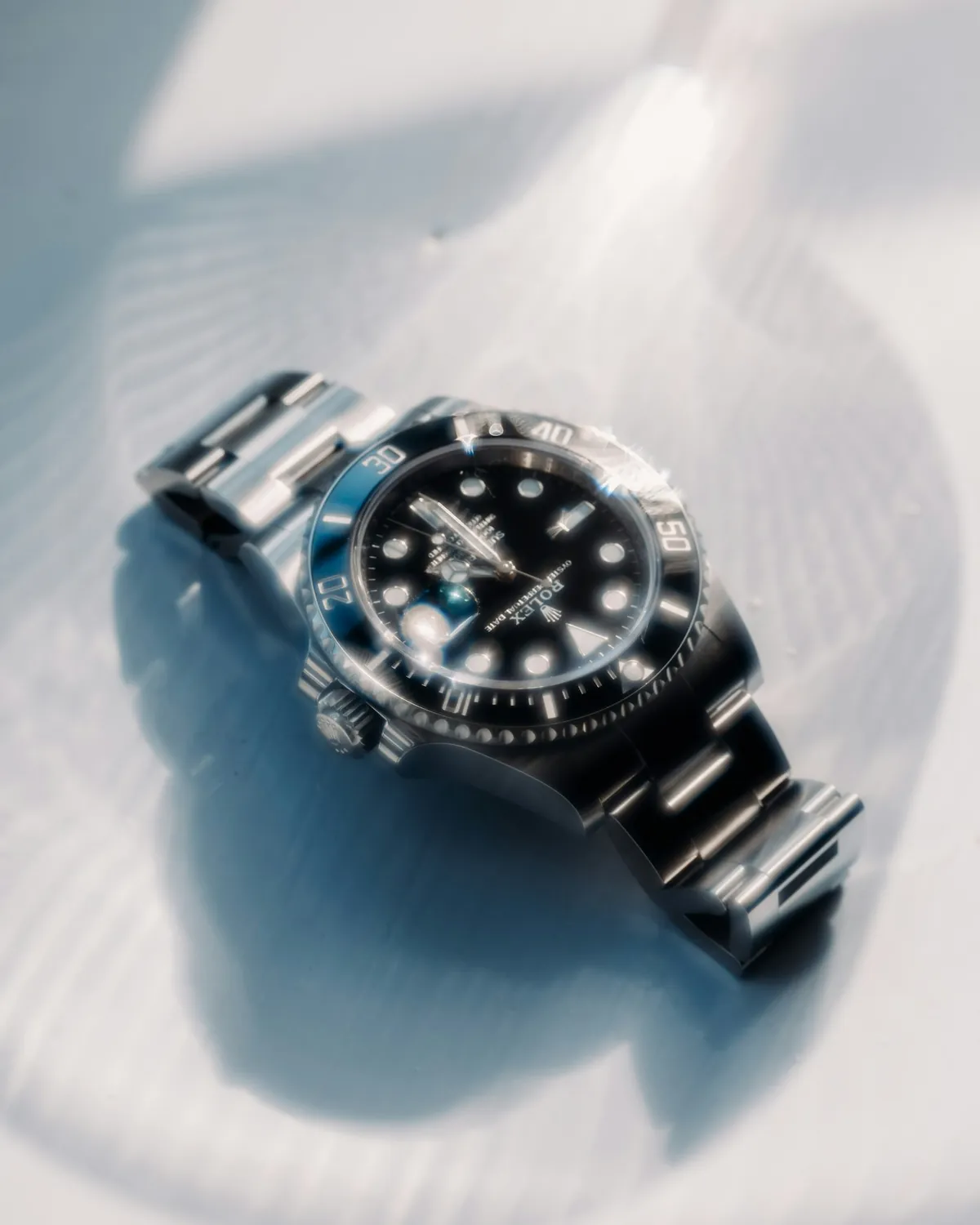
Submariner Date 116610LN
2010–2020 ceramic Sub Date with the broad Maxi case: prices, changes and clone checks. Discontinued
Submariner 114060
The 2012–2020 ceramic no-date Sub: what changed from the 14060M, prices and checks. Discontinued
Submariner Date 126610LN
The benchmark black steel Submariner Date. Most liquid reference in the line, 70-hour calibre 3235.
16610 FAQ
What movement is in the Rolex 16610?
Every 16610 uses the calibre 3135, an automatic COSC chronometer with 31 jewels, a 28,800 vph beat and about 48 hours of reserve. It has a free-sprung Microstella balance and a Breguet overcoil. Later watches may carry a blue Parachrom hairspring. See our service guide for typical intervals.
How do I tell what year my Submariner 16610 is?
Read the serial engraved between the lugs at 6 o'clock. Its letter prefix dates the case, from R and L in the late 1980s to V and G at the end. Late watches also repeat it on the rehaut. Our serial guide has the full table.
Is a tritium Submariner 16610 worth more?
Usually a little, but only when everything matches. A 'SWISS – T < 25' dial with hands that aged to the same cream tone earns a premium. With bright replacement hands or heavy polishing, it sells at the ordinary band.
Does the 16610 have solid end links?
Later ones do. Early watches used hollow end links, and solid ones arrived around 2000. Many older watches received them at service. So solid end links on a 1990 watch are not a red flag, but they are not original either.
Is the 16610LV Kermit the same as the 16610?
It shares the case, calibre and bracelet. However, the green aluminium bezel and larger markers make the 2003–2010 Kermit a separate, much pricier market. Early 'Flat 4' bezels and 'Mark' dial variants add more again.
How does the 16610 wear compared with a modern Submariner?
Smaller than the numbers suggest. The case is 40 mm, like the 116610LN, but the lugs and crown guards are thin. Therefore it suits wrists from about 16 cm and slides under a cuff more easily than any ceramic Submariner.
Last updated . Written and fact-checked by the Rolex Malaysian editorial team. Specifications and prices are re-checked quarterly.