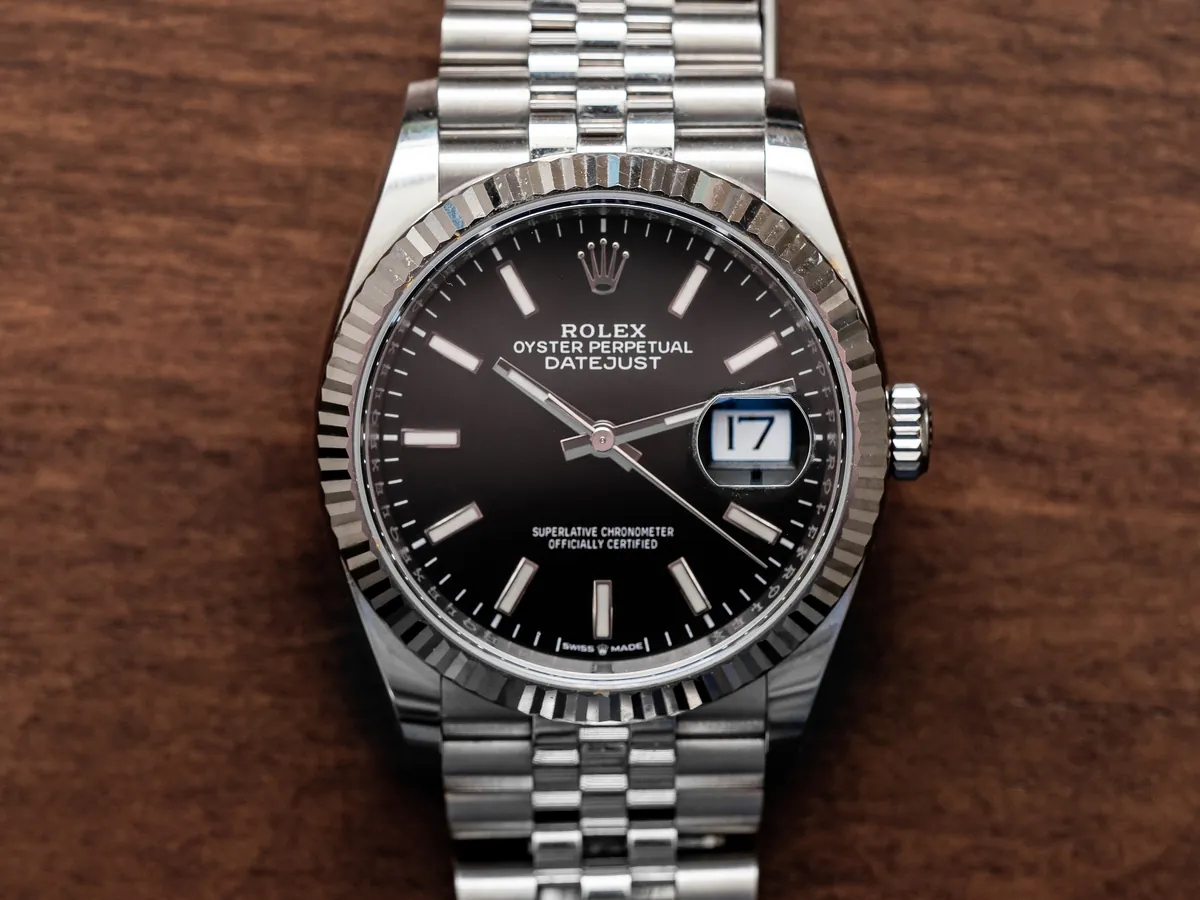
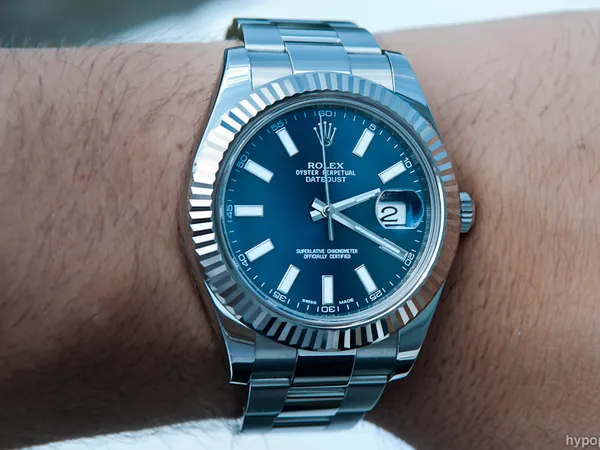
Quick answer: Datejust 36 or 41?
Buy the Datejust 36 126234 if your wrist measures under about 17 cm (6.7 in), or if you like a slim, vintage proportion. Buy the Datejust 41 126334 if your wrist is over about 17.8 cm (7 in), or if you want a modern sports-watch presence. Between those numbers, the bracelet decides: a Jubilee makes the 41 wearable, while an Oyster makes the 36 look sharper.
Mechanically, the two are the same watch. Both run calibre 3235, both carry a fluted 18 ct white-gold bezel, and both share the same 2026 dial line-up. So the real trade-offs are fit, about US$1,550 in list price, and a stronger resale premium on the 41. We do not sell watches, so the advice below is about fit and value, not stock.
126234 vs 126334: specifications side by side
The table below comes from our reference data. Note that Rolex does not publish case thickness or lug-to-lug length, so those appear later as measured approximations.
| Spec | Datejust 36 126234 | Datejust 41 126334 |
|---|---|---|
| Case diameter | 36 mm | 41 mm |
| Case material | White Rolesor (Oystersteel and 18 ct white gold) | White Rolesor (Oystersteel and 18 ct white gold) |
| Bezel | Fluted 18 ct white gold bezel | Fluted 18 ct white gold bezel |
| Dial options | Silver, Black, White Roman, Blue, Mint green, Slate Wimbledon, Palm motif, Fluted motif, Green ombre (2026), Diamond-set and mother-of-pearl variants | Silver, Black, Blue, Slate, Mint green, Slate Wimbledon, Blue fluted motif, Green ombre (2026, 126334-0033), Bright blue Roman (2026), Diamond-set variants |
| Calibre | 3235 | 3235 |
| Power reserve | 70 hours | 70 hours |
| Water resistance | 100 m | 100 m |
| Bracelet / strap | Oyster, flat three-piece links, Folding Oysterclasp with 5 mm Easylink comfort extension (Oystersteel); or Jubilee, five-piece links, concealed folding Crownclasp (Oystersteel) | Oyster, flat three-piece links, Folding Oysterclasp with 5 mm Easylink comfort extension (Oystersteel); or Jubilee, five-piece links, concealed folding Crownclasp (Oystersteel) |
| Introduced | 2019 | 2017 |
| Status | Current production | Current production |
| Retail price (US) | US$10,100 | US$11,650 |
| Retail price (Malaysia) | RM43,850 | RM50,600 |
| Pre-owned (excellent, box & papers) | US$10,000 – US$12,000 | US$13,000 – US$15,500 |
The headline 5 mm difference in diameter understates the change. In practice, the 41 is longer, wider at the lugs and has a bigger dial opening, so it looks closer to a 39–40 mm sports watch than to a scaled-up 36.
Rolex Datejust 36 vs 41 size guide by wrist circumference
Most size advice uses diameter alone. However, the number that decides fit is lug-to-lug. That is the distance from the top lug tips to the bottom lug tips. If that length overhangs the flat top of your wrist, the watch looks too big, whatever the diameter.
The dimensions that matter
| Dimension | Datejust 36 (126234) | Datejust 41 (126334) |
|---|---|---|
| Case diameter | 36 mm | 41 mm |
| Lug-to-lug | about 43–44 mm | about 47–48 mm |
| Lug width | 20 mm | 21 mm |
| Thickness | just under 12 mm | just under 12 mm |
| Visual effect | Dress-watch, vintage proportion | Modern, sport-watch presence |
Because the thickness is almost identical, the 36 looks taller relative to its width. That is why it sits like a classic dress watch. By contrast, the 41 spreads the same height over a wider footprint, so it looks flatter and more contemporary.
Wrist-size chart (cm and inches)
| Wrist circumference | Datejust 36 | Datejust 41 |
|---|---|---|
| Under 15.5 cm (6.1 in) | Good fit; also consider the Datejust 31 | Overhangs; not recommended |
| 15.5–16.5 cm (6.1–6.5 in) | Ideal | Lugs reach the wrist edges; Jubilee only |
| 16.5–17.8 cm (6.5–7 in) | Classic, understated | Works, especially on Jubilee |
| 17.8–19 cm (7–7.5 in) | Vintage look; reads small to some | Ideal |
| Over 19 cm (7.5 in) | Clearly small; a deliberate style choice | Ideal |
Measure with a strip of paper just above the wrist bone, then lay it against a ruler. Also check the flat top of your wrist, seen from above. If it is narrower than about 47 mm, the 41's lugs will touch the edges. Many Malaysian and East Asian buyers have flatter, narrower wrists than the circumference suggests. As a result, the 36 is often the better fit than a chart predicts.
Design and wearability
Case, bezel and dial
Both references use White Rolesor: an Oystersteel case and bracelet with an 18 ct white-gold fluted bezel. The gold is brighter and whiter than the steel, and the flutes catch light more sharply than a smooth bezel. On the 41, the bezel is relatively narrower, so the dial looks larger in proportion.
The dial menus overlap almost completely. For example, both offer the slate Wimbledon, mint green, blue fluted motif and the 2026 green ombre. Rolex also redesigned its Roman-numeral dials for 2026 with sans-serif applied numerals. Therefore, pre-2026 and 2026 Roman dials now look different, which may matter to resale later.
Oyster or Jubilee
Bracelet choice changes the size question more than most buyers expect. The Jubilee has five small links that drape around the wrist. In contrast, the Oyster has three flat links that sit higher and look bolder. So a 41 on Jubilee wears smaller than a 41 on Oyster, while a 36 on Oyster looks sportier than a 36 on Jubilee.
Comfort also differs. The Oyster uses the Oysterclasp with a 5 mm Easylink extension, which helps in Malaysian heat when wrists swell. The Jubilee uses the concealed Crownclasp, which looks cleaner but has no quick extension. Our Rolex bracelet guide covers both in detail.
Movement and function
Here, the comparison is a draw. Both watches use calibre 3235, introduced in 2015 and fitted to the current Datejust generation. It offers about 70 hours of power reserve, a Chronergy escapement, a blue Parachrom hairspring and Paraflex shock absorbers. Rolex certifies it as a Superlative Chronometer, accurate to −2/+2 seconds a day after casing.
The date jumps instantly at midnight, and the Cyclops lens magnifies it 2.5 times. Water resistance is 100 m on both. In other words, you are not giving up any function by choosing the smaller case. If you want to understand the date mechanism, compare these with the no-date Datejust vs Oyster Perpetual page.
Price comparison: retail and pre-owned
The table below covers the two White Rolesor references plus the plain steel versions, the 126200 and 126300, for context.
| Reference | Retail | Unworn, full set | Excellent, B&P | Good, no papers | Mid-band vs retail |
|---|---|---|---|---|---|
| Datejust 36 126234 | US$10,100 | US$11,000 – US$13,000 | US$10,000 – US$12,000 | US$8,800 – US$10,300 | +9% |
| Datejust 41 126334 | US$11,650 | US$14,500 – US$17,000 | US$13,000 – US$15,500 | US$11,500 – US$13,500 | +22% |
| Datejust 36 126200 | US$8,150 | US$9,000 – US$10,500 | US$8,000 – US$9,500 | US$7,000 – US$8,200 | +7% |
| Datejust 41 126300 | US$8,950 | US$10,000 – US$12,000 | US$9,000 – US$10,800 | US$8,000 – US$9,300 | +11% |
Retail is the current (or last) US list price. Pre-owned bands are rounded market ranges for October 2026; MYR ≈ USD × 4.08.
What the premium costs you
At retail, the 126334 lists at US$11,650 against US$10,100 for the 126234. In Malaysia, authorised dealers list them at RM50,600 and RM43,850 respectively. So moving up to the 41 costs about US$1,550, or RM6,750, at an AD.
On the pre-owned market the gap widens. An excellent 126334 with papers trades around US$13,000 – US$15,500, while a 126234 trades around US$10,000 – US$12,000. That puts the 41 roughly 22% over retail and the 36 about 9% over. In short, the 41 is more expensive to buy used, but it also returns more of its price when sold.
New vs pre-owned
Both references are among the easier Rolex models to buy at retail in 2026, especially with silver or black dials. Therefore, paying a grey-market premium for a plain dial rarely makes sense. Popular dials are different: Wimbledon and mint green 41s ask US$14,000–18,000, and the AD queue for them is longer.
A good-condition watch without papers trades around US$11,500 – US$13,500 for the 41 and US$8,800 – US$10,300 for the 36. That discount is real, but papers matter for resale. Our box and papers guide explains the trade-off, and the retail vs market price guide explains why plain dials sit near list.
Ownership, servicing and resale
Servicing
Service costs are effectively identical, since the movement is the same. Rolex recommends a service roughly every ten years, and the international warranty runs five years from the date on the card. A full service at a Rolex service centre includes the bracelet and case refinishing on request. Our Rolex service guide explains costs and the polishing question.
Polishing the fluted bezel
The white-gold flutes are the part buyers inspect first. Heavy polishing rounds their sharp peaks, and that is permanent. So decline bezel polishing at service, and check flute sharpness under a loupe when buying used. Also check the Cyclops, the rehaut engraving and the serial against the card; our real vs fake Rolex guide walks through each step.
Resale over five years
Market data show the 126234 up about 36% over five years and the 126334 up about 27%, with both gaining roughly 9–10% in the year to April 2026. Much of that came from Rolex's own price rises lifting the floor. Past gains are not a forecast, though. Expect plain dials to track retail and popular dials to keep a premium.
Mistakes we see
- Choosing the 41 from a diameter chart without checking lug-to-lug against the top of the wrist.
- Paying a grey-market premium for a silver or black dial that an AD can supply.
- Adding an aftermarket diamond bezel, which cuts resale sharply.
- Buying a "Datejust II" 116334 by mistake: it is 41 mm but has a wider bezel and the older calibre 3136.
- Ignoring the bracelet: an Oyster-only try-on often pushes buyers to the wrong size.
Which Datejust should you buy?
Choose the Datejust 36 if…
- your wrist is under about 17 cm (6.7 in), or flat and narrow from above;
- you want a dress watch that slides under a cuff and looks period-correct;
- you prefer the classic Jubilee-and-fluted-bezel look of the original 1945 Datejust;
- you want the lower entry price, at US$10,100 retail.
Choose the Datejust 41 if…
- your wrist is over about 17.8 cm (7 in);
- you already wear 39–42 mm sports watches and the 36 looks small to you;
- you want the stronger resale premium of the 126334;
- you want the larger dial for legibility, especially on Wimbledon or mint green.
Not sure about the fluted bezel at all? The steel 126200 and 126300 cost less, and the Datejust collection page covers every metal. For a first purchase, our first Rolex buying guide also compares the Datejust with sports models.
Verdict
For most wrists between 16 and 18 cm, the Datejust 36 is the more elegant watch and the better fit, and it costs less. Choose the Datejust 41 if your wrist is over 7 inches or you want a modern look; it also holds value better. Either way, pick your dial first, try it on the right bracelet, and buy from a seller who can show matching papers.
Datejust 36 vs 41 FAQ
Is a 36mm Rolex too small for a man?
No. Thirty-six millimetres was the standard men's Datejust size from 1945 until the 2000s, and many men still choose the 126234 today. On wrists up to about 17.5 cm (6.9 in) it looks correctly proportioned. It only starts to read small above roughly 19 cm (7.5 in), and even then plenty of owners prefer the vintage look.
What wrist size suits a Datejust 41?
The Datejust 41 suits wrists from about 17 cm (6.75 in) upwards, and it looks most natural from 17.8 cm (7 in). The deciding number is lug-to-lug: at roughly 47–48 mm it should sit inside the flat top of your wrist. On a Jubilee bracelet the 41 drapes better and can work on slightly smaller wrists.
Do the Datejust 36 and 41 use the same movement?
Yes. The 126234 and 126334 both use calibre 3235: automatic, about 70 hours of power reserve, Chronergy escapement, blue Parachrom hairspring and an instant date change at midnight. Accuracy is certified to −2/+2 seconds a day after casing. Neither size has a mechanical advantage.
Which holds its value better, the Datejust 36 or 41?
In October 2026 the 126334 holds value better. Excellent examples with papers trade around US$13,000–15,500 against a US$11,650 list price, roughly 22% above retail. The 126234 sits about 9% over its US$10,100 list. Both figures depend heavily on dial: Wimbledon and mint green lead, while silver and black trail.
Is the Datejust 41 too big for a suit?
Usually not. Both sizes are just under 12 mm thick, so the 41 slides under a shirt cuff as easily as the 36. The real issue is width: on a slim wrist the 41's extra lug length can push against a tailored cuff. If you mostly wear fitted shirts, try the 41 on with one before buying.
How much is the Rolex Datejust 41 in Malaysia?
Malaysian authorised dealers list the 126334 (fluted white-gold bezel, Oyster bracelet) at RM50,600 as of October 2026, against RM43,850 for the 126234. Grey dealers in Kuala Lumpur generally ask more for popular dials. Always compare a grey price with the official RM list and our used Rolex price guide.
Last updated . Written and fact-checked by the Rolex Malaysian editorial team. Specifications and prices are re-checked quarterly.