Quick answer
Choose the Datejust 36 126200 if you want a date, the option of a Jubilee bracelet and a slightly dressier watch. Choose the Oyster Perpetual 36 126000 if you want the simplest, cleanest Rolex and bright lacquer dial colours. The OP costs US$6,750 new against US$8,150, a gap of US$1,400. Used, however, the order can flip when the OP has a sought-after dial.
Overall, these two share a 36 mm Oystersteel case, a smooth domed bezel, a 70-hour movement and 100 m water resistance. So the decision is about function and style, not quality.
Datejust vs Oyster Perpetual specifications
Specifically, the table comes straight from our reference data. Note that Rolex does not publish case thickness for either watch, so that row is blank.
| Spec | Datejust 36 126200 | Oyster Perpetual 36 126000 |
|---|---|---|
| Case diameter | 36 mm | 36 mm |
| Case material | Oystersteel | Oystersteel |
| Bezel | Smooth domed Oystersteel bezel | Smooth domed, polished Oystersteel |
| Dial options | Silver, Black, White, Blue, Mint green, Slate Wimbledon (green Roman), Palm motif, Green ombre (2026), Bright blue Roman (2026), Diamond-set variants | Silver, Bright blue, Bright black, Green, Candy pink, Turquoise blue, Yellow, Coral red, Celebration motif (2023-2025), Beige (matte lacquer, 2025), Jubilee motif multicolour ROLEX monogram (2026) |
| Calibre | 3235 | 3230 |
| Power reserve | 70 hours | 70 hours |
| Water resistance | 100 m | 100 m |
| Bracelet / strap | Oyster, flat three-piece links, Folding Oysterclasp with 5 mm Easylink comfort extension; or Jubilee, five-piece links, concealed folding Crownclasp (Oystersteel) | Oyster, three-piece links; folding Oysterclasp with 5 mm Easylink extension |
| Introduced | 2019 | 2020 |
| Status | Current production | Current production |
| Retail price (US) | US$8,150 | US$6,750 |
| Retail price (Malaysia) | RM35,300 | RM29,050 |
| Pre-owned (excellent, box & papers) | US$8,000 – US$9,500 | US$7,600 – US$10,500 |
The rows that differ are the calibre, the crystal, the bracelet and the dial list. Otherwise, everything is essentially shared. In other words, you are choosing between two versions of the same case.
Design and wearability
The dial: date window or clean symmetry
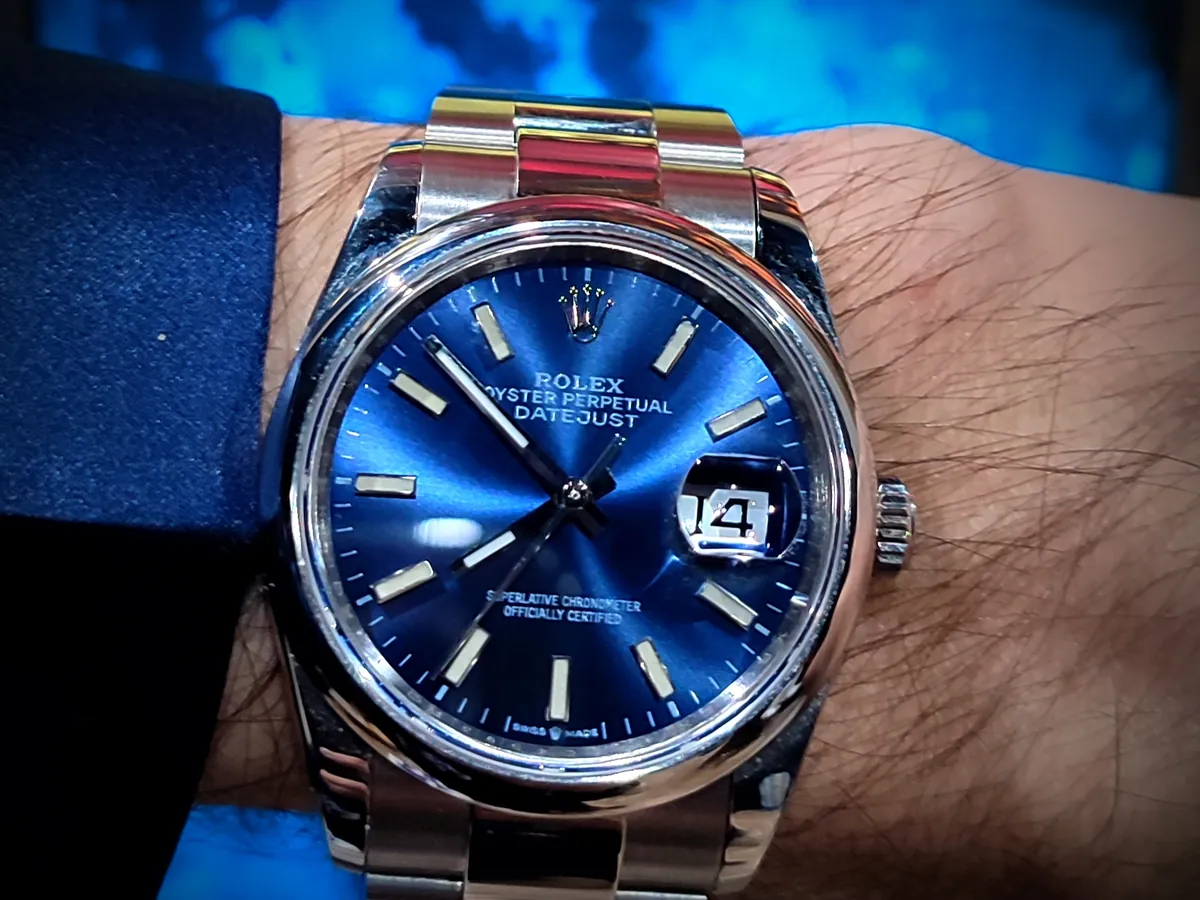
The Datejust's defining feature is the date at 3 o'clock under a Cyclops lens that magnifies it about 2.5 times. It has been there since the 1950s, and it is what most people picture when they think of a Rolex. Therefore the 126200 reads as a "classic Rolex" from across a room.
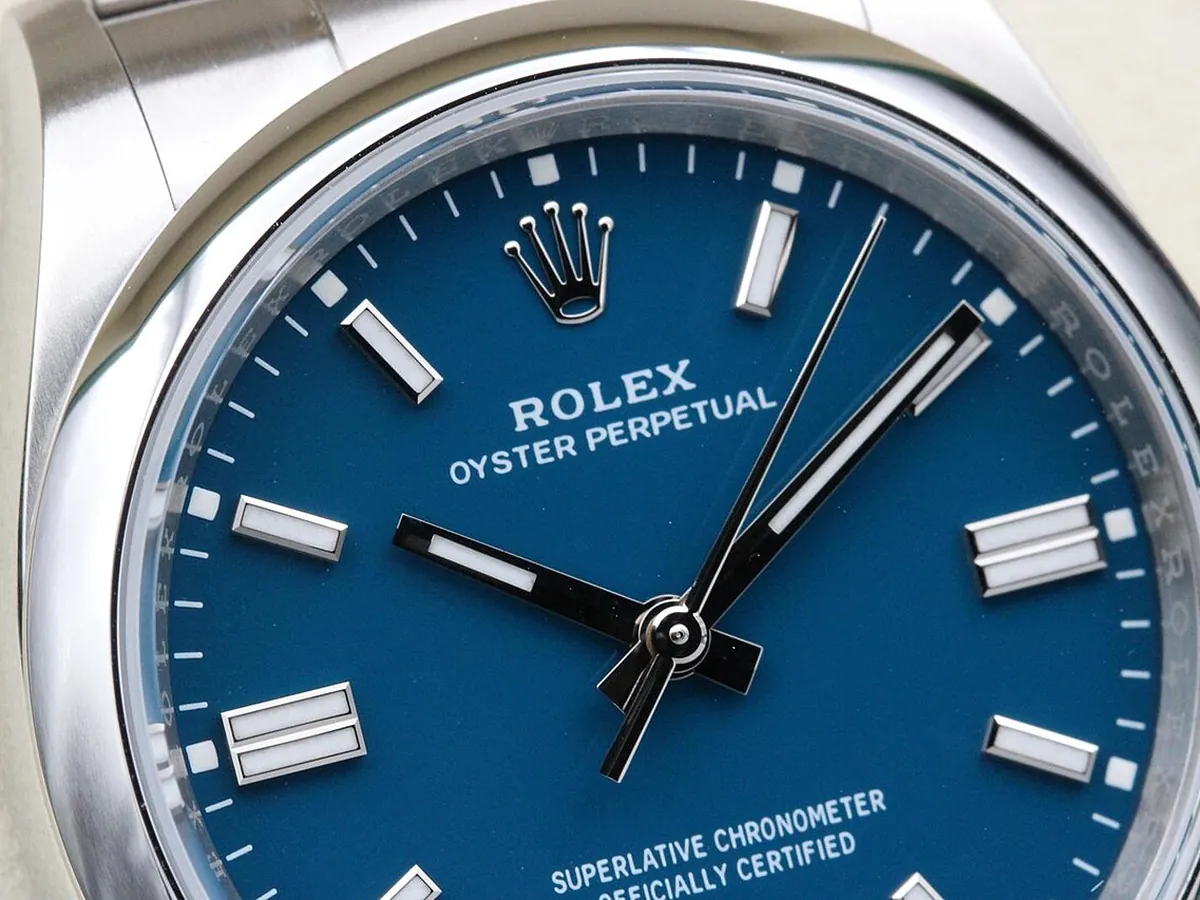
By contrast, the 126000 has no date and no Cyclops. As a result, the dial is symmetrical and the crystal is flat. That also suits its colour dials, which run from silver and black to turquoise blue, candy pink, yellow, coral red and green. In 2026, for the Oyster's centenary, Rolex added a silver dial with a multicolour ROLEX Jubilee monogram. The Datejust has colour too, notably mint green and the Wimbledon slate dial, but in a more formal style with applied indices or Roman numerals.
Bracelet options
This is, above all, the biggest practical difference. The 126200 comes on either the Oyster bracelet or the five-link Jubilee with a hidden Crownclasp. In particular, the Jubilee is lighter-looking, drapes more closely and dresses the watch up. By contrast, the 126000 is sold only on the Oyster bracelet with a folding Oysterclasp and 5 mm Easylink extension.
Still, both bracelets are comfortable in Malaysian heat, and Easylink gives you a little room on humid days. If you want a deeper look at the options, read our Rolex bracelets and clasps guide.
On the wrist
Both cases are 36 mm with short lugs. Consequently, they suit a wide range of wrists, from about 15 cm to 18 cm (5.9–7.1 in). The Datejust's Cyclops adds a small bump on the crystal, and the Jubilee makes it look a little smaller and dressier. The OP, by contrast, looks sportier, especially on a bright dial. Both are popular with women as well as men, and the 36 mm size sells strongly across Asia.
However, a smooth steel bezel shows scratches on both. If you prefer something that hides wear and catches light, consider the fluted white gold bezel of the Datejust 126234. It costs US$10,100, and it has no OP equivalent.
Movement and function
In fact, the two calibres are siblings. The 126200 uses calibre 3235, and the 126000 uses calibre 3230. As a result, both have the Chronergy escapement, a blue Parachrom hairspring, Paraflex shock absorbers and a 70-hour power reserve. Both are Superlative Chronometers tested to −2/+2 seconds a day after casing.
The only functional difference is the date. The 3235 has an instantaneous date that jumps at midnight and can be set quickly through the crown. The 3230 removes that mechanism. For owners, that means one less thing to set after the watch stops. It also means one less thing to go wrong, although Rolex date mechanisms are very reliable.
Servicing is similar for both. Rolex suggests roughly ten-year intervals for its current calibres, and the parts are common. Our service and value guide covers what a service involves and how it affects resale.
Price comparison: retail and pre-owned
| Reference | Retail | Unworn, full set | Excellent, B&P | Good, no papers | Mid-band vs retail |
|---|---|---|---|---|---|
| Datejust 36 126200 | US$8,150 | US$9,000 – US$10,500 | US$8,000 – US$9,500 | US$7,000 – US$8,200 | +7% |
| Oyster Perpetual 36 126000 | US$6,750 | US$9,500 – US$12,500 | US$7,600 – US$10,500 | US$6,500 – US$9,700 | +34% |
Retail is the current (or last) US list price. Pre-owned bands are rounded market ranges for October 2026; MYR ≈ USD × 4.08.
New, the gap is simple. In the US, the 126200 on an Oyster bracelet costs US$8,150, and the 126000 costs US$6,750. In Malaysia, the list prices are RM35,300 and RM29,050, a difference of RM6,250. The Jubilee bracelet adds about US$300 to the Datejust.
Why the used OP band is so wide
With papers, the 126000 trades at US$7,600 – US$10,500. That is a US$2,900 spread, against US$1,500 for the Datejust. The reason is dials. Silver and black OP 36s trade close to retail. Meanwhile, turquoise blue and the discontinued Celebration dial ask about US$13,000 to US$16,500. So "the OP price" is really several prices, and you need to price the exact dial.
Why the Datejust sits near retail
The steel Datejust 36 is made in larger numbers and in many dial and bracelet combinations. As a result, it trades in a narrower band of US$8,000 – US$9,500 with papers, close to its list price. Mint green, Wimbledon, the palm motif and the new green ombre dial sit at the top of that range. Silver, black and white sit at the bottom.
Ownership and resale
Availability
Neither is the hardest Rolex to get. Still, the popular OP dials, especially turquoise, have been difficult to buy at retail since the 126000 launched in 2020. Basic Datejust configurations are usually easier. In Kuala Lumpur, as elsewhere, authorised dealers allocate stock to existing clients first. Our retail vs market price guide explains how that works.
Resale
The resale picture follows the dial. A plain OP 36 or a plain Datejust 36 will sell close to retail. A turquoise OP has historically sold far above it, but colour trends can change, so do not pay a large premium expecting it to last. The Datejust tends to be steadier: WatchCharts tracked the 126200 at about 8,570 USD in March 2026, near its list price.
Authentication
Both are common fakes. For the Datejust, check the Cyclops magnification and its centring over the date. For the OP, check the dial colour against Rolex photos, since clones often get turquoise and coral slightly wrong. On both, look for the laser-etched crown in the crystal and a rehaut serial that matches the card. Our real vs fake Rolex guide walks through every check.
Which 36 mm Rolex should you choose?
Choose the Datejust 36 126200 if…
- You will use the date every day.
- You want the Jubilee bracelet.
- You prefer a dressier, more formal dial.
- You want steady resale close to retail.
Choose the Oyster Perpetual 36 126000 if…
- You want a symmetrical dial with no Cyclops.
- You love bright lacquer colours.
- You want the lowest retail price for a 36 mm Rolex.
- You prefer the sportier look of the Oyster bracelet.
Still unsure? Our first Rolex buying guide lists other options at this budget. The Explorer 36 124270 is the obvious third choice, with the same no-date calibre in a tool-watch style.
Verdict
Comparing the Rolex Datejust vs Oyster Perpetual, the better watch depends on one question: do you want a date? If you do, the 126200 is the more complete daily Rolex, with the Jubilee option and resale that tracks its list price. If you do not, the 126000 is purer, cheaper at retail and more fun, as long as you buy the dial on its own price rather than on hype.
Datejust or Oyster Perpetual FAQ
Is the Datejust worth more than the Oyster Perpetual?
At retail, yes: the 126200 lists at US$8,150 against US$6,750 for the 126000. Used, it depends on the dial. A silver or black OP 36 trades close to retail, whereas turquoise and Celebration dials sell far above it. A Datejust 36 with papers trades at US$8,000 – US$9,500, close to its list price, with mint green and Wimbledon dials at the top.
Date or no date: which Rolex should I get?
Choose the date if you use it. A date is genuinely handy for signing documents and travel, and the Datejust's Cyclops makes it easy to read. Choose no date if you want a symmetrical dial and a slightly simpler watch. The no-date OP also avoids the one setting rule that worries some owners: not changing the date late at night.
Is the Oyster Perpetual a real Rolex?
Yes. The Oyster Perpetual is Rolex's base collection, made in the same workshops as every other model. The 126000 has an in-house calibre 3230 with Chronergy escapement, Parachrom hairspring and 70-hour reserve, and Rolex certifies it to the same −2/+2 seconds a day as a Datejust or Submariner. Every Rolex dial says Oyster Perpetual because the name refers to the case and rotor.
Does the Datejust 36 come on a Jubilee bracelet?
Yes. The 126200 is offered on either the three-link Oyster bracelet with Oysterclasp or the five-link Jubilee with a concealed Crownclasp. The Jubilee adds about US$300 at retail and a small premium used. The OP 36 is only sold on the Oyster bracelet, which is one of the clearest practical differences between them.
Is a 36 mm Rolex too small for a man?
Not usually. Both watches are 36 mm with short lugs, which suits wrists up to about 17.5 cm (6.9 in) well. On larger wrists they look deliberately classic. If you want more presence, the Datejust 36 vs 41 and Oyster Perpetual 36 vs 41 pages compare the bigger versions.
Last updated . Written and fact-checked by the Rolex Malaysian editorial team. Specifications and prices are re-checked quarterly.