Real vs fake Rolex: why a tiered method works
Most "how to spot a fake" lists give you fifteen tricks in random order. That is the wrong way round. Some checks take ten seconds and kill a cheap fake on the spot. Others need a loupe and good light. A few need a watchmaker and a case-opening tool. So the sensible approach is to escalate only when a watch survives the easier tests.
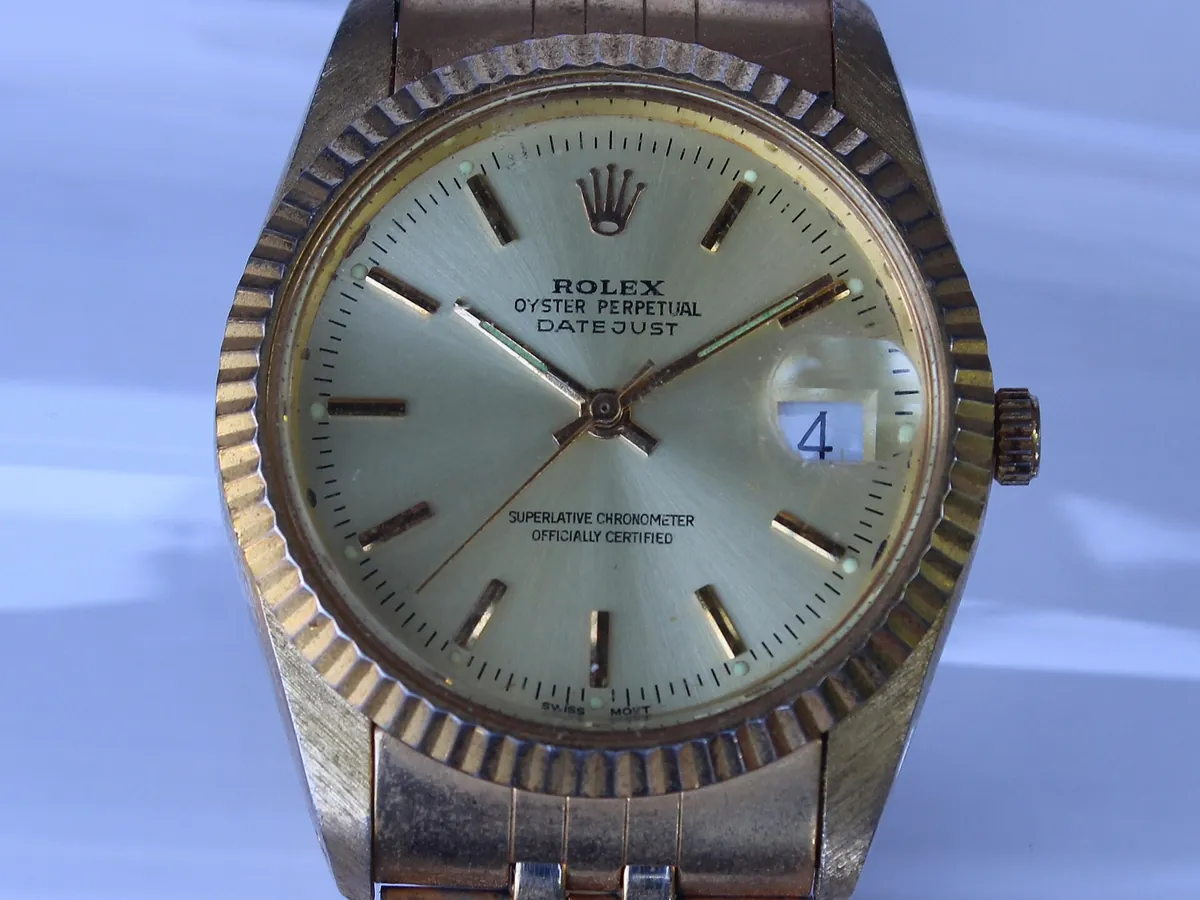
This guide follows that order. Tier one is what you can do across a café table. Tier two is ten minutes with a 10x loupe. Tier three is what only a bench inspection can confirm. After that, we cover super clones, serial numbers, paperwork, altered watches, safe buying and your options if a real vs fake Rolex question was answered too late.
Tier 1: ten-second checks that catch cheap fakes
These checks need no tools. They will not catch a super clone, but they separate real watches from the bulk of the fakes still sold at night markets, on social media and through "too good to be true" marketplace ads.
The price and the story
The fastest tell is not on the watch at all. A current steel Submariner Date 126610LN in good condition without papers trades around US$12,300 – US$13,700. Therefore an asking price half of that is not a bargain; it is a warning. Likewise, sellers who refuse to meet, push for a bank transfer, or claim the watch is "from a friend's estate, no papers" deserve extra care. Our used Rolex prices guide lists the condition bands for every reference.
The seconds hand
Watch the seconds hand for a few seconds. A quartz fake ticks once per second, which no real Rolex does. By contrast, most genuine Rolex calibres beat at 28,800 vibrations per hour, so the hand moves in eight small steps each second. To the eye, that reads as a smooth, slightly stuttering glide. Cheaper automatic fakes often run at 21,600, which looks a little choppier than the real thing.
Genuine: seconds-hand sweep
- 28,800 vph: eight small steps per second, reads as a smooth glide on video
- Steady amplitude, no stutter when the watch is tilted
- A quiet, fine-grained ticking close to the ear
Warning signs
- Visibly choppier steps (often 21,600 vph or slower)
- A single one-second tick means a quartz movement
- Loud, rattly rotor noise when the watch is shaken
One exception matters. The Land-Dweller's calibre 7135 runs at 5 Hz, so its hand moves in ten steps per second. See the Land-Dweller 127334 page for that reference.
Weight, crown and caseback
A genuine steel Rolex feels dense and solid; links do not rattle. Light, tinny fakes that feel nothing like a real Rolex still exist, although better clones now match the weight closely. Next, unscrew the crown. It should unthread smoothly, pop out and wind with a fine, quiet feel. Gritty winding or a crown that will not seat flush is a red flag.
Then turn the watch over. Classic Oyster models such as the Submariner, GMT-Master II and Datejust have a plain, solid screw-down back with no window and no engraving. A see-through back on one of those references means the watch is fake, or a real watch with an aftermarket back. However, a few models really do have display backs, as the caseback diagram below explains.
Genuine: caseback
- Solid Oystersteel or gold, fluted edge for the case wrench
- No engraving on most models (some are factory-engraved, e.g. Sea-Dweller and Deepsea)
- Display backs are factory-fitted only on certain models (e.g. some Daytona, 1908, Land-Dweller)
Warning signs
- Exhibition window on a model Rolex makes with a solid back
- Stickers or decorative engravings sold as 'factory'
- Back that turns too easily or sits proud of the case
Tier 2: ten-minute checks with a loupe
Buy a 10x jeweller's loupe before you view any watch; it costs less than a meal. Then examine the dial in daylight or under a bright white lamp. In this tier, you are looking for the small manufacturing compromises that separate a real watch from a fake, even when the overall look is right.
Cyclops magnification and clarity
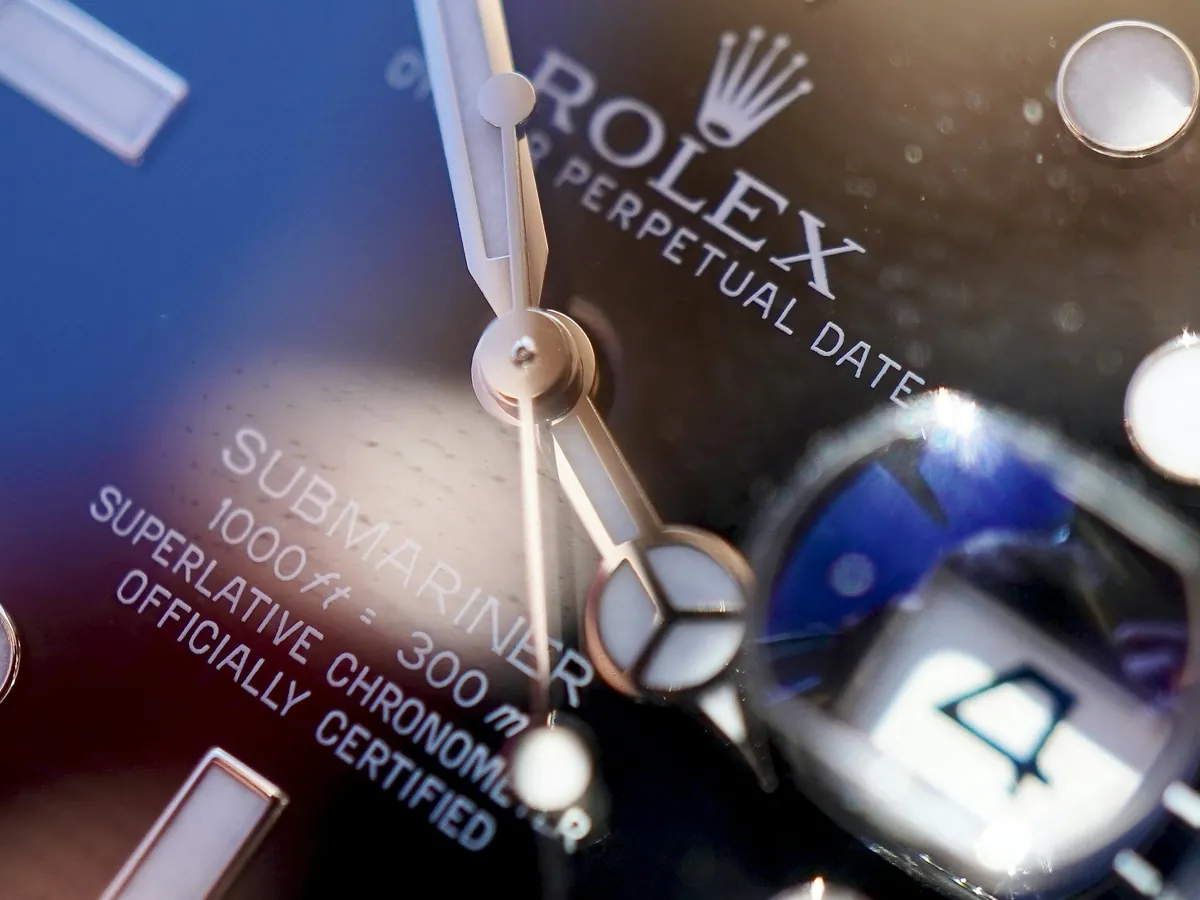
Rolex's Cyclops lens magnifies the date about 2.5 times, so the numerals fill the lens. Many fakes still use a weaker lens than the real one, which leaves the date looking small with a visible margin. Also check that the lens sits exactly over the date window. A strong blue or purple sheen on top of the lens is another warning sign, because a genuine lens looks clear from most angles.
Genuine: cyclops magnification
- Date fills the lens edge to edge
- Numerals stay sharp right to the lens rim
- Lens sits centred over the date window
Warning signs
- Date looks small, with a visible margin
- Lens slightly off-centre or bubbled
- Strong blue anti-glare tint on top of the lens
Rehaut engraving and the serial at 6
From the mid-2000s, Rolex began engraving the inner flange, or rehaut, with a repeating ROLEX inscription. The serial number sits in that ring at 6 o'clock. On a genuine watch, every letter and coronet lines up with its minute marker all the way round. For example, the coronet at 12 should sit dead centre on the 60-minute mark. Fakes often drift slightly as the text circles the dial, while a real ring stays true.
Genuine: rehaut engraving alignment
- Each engraved crown and letter lines up with its minute marker
- Engraving is crisp, even in depth, and readable at 12 o'clock
- Serial number engraved on the rehaut at 6 on modern pieces
Warning signs
- Letters drift between markers as they go around the ring
- Shallow, sandy-looking or uneven engraving
- Serial at 6 printed rather than engraved, or wrong format
Older watches complicate this. A Submariner 16610 from the 1990s has a plain rehaut, and that is correct. So an engraved rehaut on a watch whose papers say 1998 is itself suspicious.
The laser-etched crown in the crystal
Since the early 2000s, Rolex has laser-etched a tiny coronet into the sapphire crystal just above 6 o'clock. On a real watch it is made of minute dots and is hard to find even when you know where to look. You usually need the loupe and a raking angle of light. Fakes often make the etching bolder and frosted, so it is easier to see head-on than a real one. Ironically, an etching that is easy to find counts against the watch.
Genuine: laser-etched crown at 6 o'clock
- Made of tiny dots, hard to find without a loupe
- Sits in the crystal just above the 6 o'clock marker
- Present on most Rolex crystals from the early 2000s onward
Warning signs
- Bold and frosted, easy to spot head-on
- Solid lines instead of a dot matrix
- Off-centre, or placed on a reference/era that would not have it
Dial printing and markers
Under 10x, genuine Rolex printing has sharp edges, even ink density and perfectly spaced letters. Look at the small text at 6 o'clock in particular, because that is where shortcuts show. For example, the 41 mm Submariners from 2020 added a tiny coronet between "SWISS" and "MADE"; earlier models do not have it. Also check the applied hour markers. Their metal surrounds should be cleanly finished, with lume filled neatly to the edge.
Bezel action and insert
A dive bezel such as the Submariner's should turn one way only, in 120 crisp clicks, with no back-play. The GMT-Master II 126710BLNR is different: its bezel turns both ways in 24 one-hour clicks. On a two-colour GMT insert, the colours belong to one piece of ceramic. Therefore the colour boundary should be clean, never a seam between glued halves.
Genuine: bezel action and alignment
- Divers' bezels: 120 firm, evenly spaced clicks, one direction only
- Pearl or triangle lands exactly on 12 at every full click
- No back-play or wobble when pressed
Warning signs
- Fewer or mushy clicks, or it turns both ways
- Triangle stops just short of or past 12
- Gritty feel and a hollow, high-pitched sound
Lume colour and evenness
Charge the dial with a phone torch for ten seconds, then cup your hands around it. Modern Rolex Chromalight glows blue, and every plot and hand glows evenly. Green lume on a current reference, or hands that fade faster than markers, points to a fake or a real watch with replaced parts. That said, some genuine references and older watches use different lume, so check the specific reference before you judge.
Genuine: lume colour and application
- Modern pieces glow blue (Chromalight) and stay bright for hours
- Every marker and hand glows at the same intensity
- Lume plots filled neatly to the edge of the surround
Warning signs
- Green or mixed-colour glow on a modern reference
- Hands and markers fade at different rates
- Overfilled or thin, lumpy plots under a loupe
Date change at midnight
Set the time forward slowly through midnight. On a modern Rolex date calibre, the date snaps over within a minute or two of 12. By contrast, many fakes start moving the date wheel late in the evening and creep for an hour or more, which a real Rolex never does. However, better clones now jump quickly too, so a clean change is necessary rather than sufficient.
Genuine: date change behaviour
- Date snaps over within a minute or two of midnight
- Hands set back past midnight do not drag the date backwards
- Quick-set date clicks crisply in crown position 2
Warning signs
- Date starts moving around 22:00 and creeps until after midnight
- Half-turned date visible in the window for hours
- Quick-set feels gritty or needs several tries
Bracelet, clasp and finishing
Finally, examine the bracelet. Brushed and polished surfaces should meet in razor-sharp lines. The clasp logo should be cleanly milled, and the inside of the clasp should be smooth, with no burrs. Modern Rolex bracelets use screws, not friction pins, to join the links. Fakes often look as good as a real watch from above but rough underneath, because few buyers turn the clasp over.
Genuine: clasp and bracelet machining
- Crisp transitions between brushed and polished surfaces
- Clasp blade and logo cleanly milled, not stamped-looking
- Bracelet links tight, quiet, no rattle; screws not pins on modern pieces
Warning signs
- Polishing bleeds over brushed edges
- Fuzzy logo, uneven font, or stamped-in look
- Loose links, sharp burrs inside the clasp, cheap spring-loaded feel
Real vs fake checks at a glance
The table below summarises each check, what genuine looks like, what fakes typically get wrong, and how likely a 2026 super clone is to pass. The final column is the important one, because it tells you how much weight each check deserves.
| Check | What genuine looks like | What fakes get wrong | Can a super clone pass? |
|---|---|---|---|
| Price and seller | Within the market band for condition and set | Far below market; pressure to pay fast | Often, if priced realistically |
| Seconds sweep | Smooth, 8 steps per second on most calibres | Quartz tick or coarse sweep | Yes |
| Weight and feel | Dense, tight links, no rattle | Light, hollow or rattly | Usually, in steel |
| Caseback | Solid and plain on most Oyster models | Display window or engraved back | Yes |
| Cyclops | About 2.5x, centred, clear | Weak magnification, off-centre, tinted | Sometimes |
| Rehaut | Aligned to the minute track, serial at 6 | Drifting letters, shallow engraving | Often |
| Crystal coronet | Faint dot pattern, angle only | Bold, frosted or missing | Often |
| Dial print | Sharp edges under 10x | Soft, bleeding or mis-spaced text | Sometimes |
| Bezel | Exact click count, no play | Loose, mushy, wrong count | Often |
| Lume | Even blue Chromalight on modern pieces | Green or uneven glow | Often |
| Date change | Snaps over near midnight | Creeps for an hour or more | Sometimes |
| Clasp and bracelet | Crisp machining inside and out | Burrs, poor logos, loose links | Sometimes |
| Serial and papers | Consistent with each other and the era | Wrong format, mismatch, reused serial | Sometimes |
| Movement | Rolex calibre, finishing and markings | Clone parts, crude finishing | No, to a trained watchmaker |
Rolex super clone vs original: the honest picture in 2026
The fakes that cause real losses today are not the ones in tourist markets. They are super clones: copies of a single reference, made to the real watch's exact dimensions and sold online for far more than a street fake. Pretending they are easy to spot would do you a disservice.
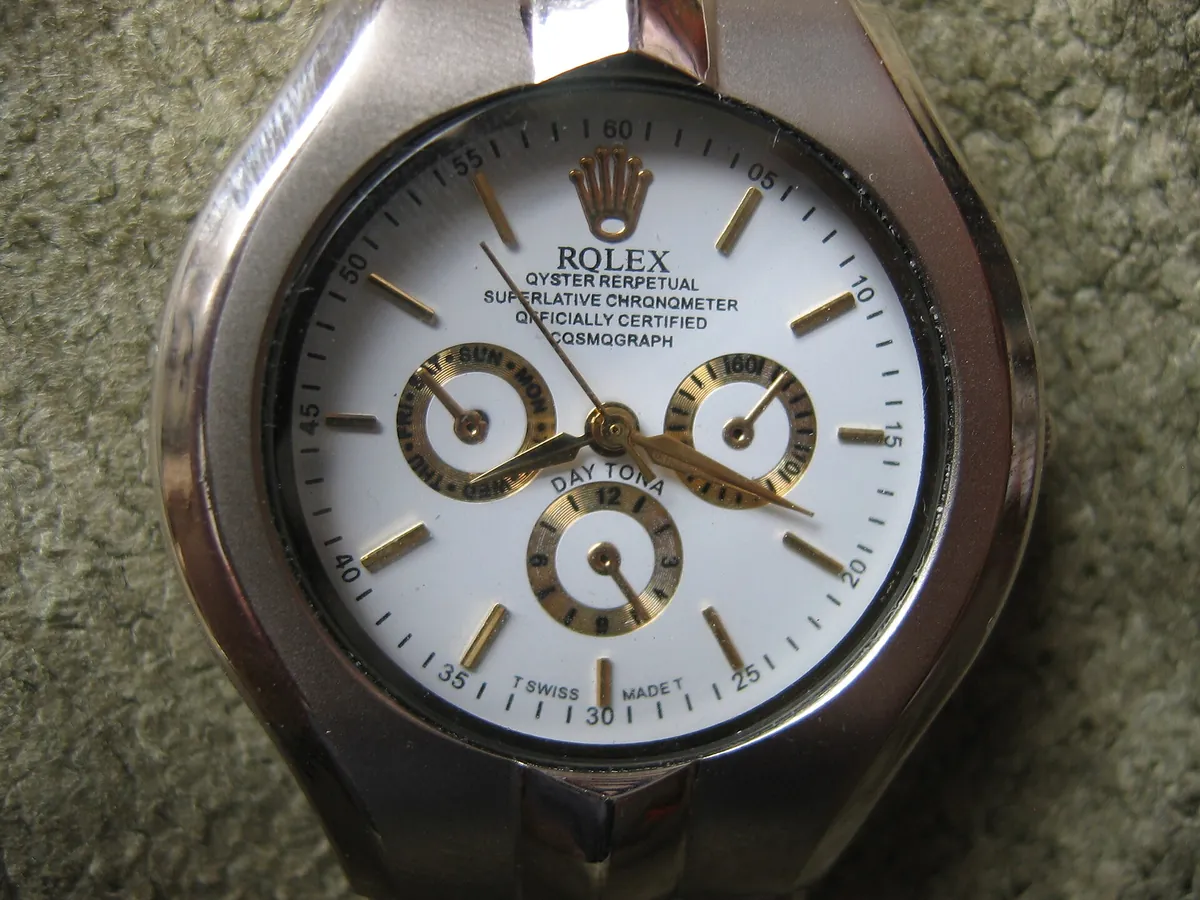
What super clones now copy well
- Dimensions and weight. Case, lugs and bracelet are measured from genuine watches, so the size and heft feel right in steel.
- Ceramic bezels. Inserts are real ceramic, with filled or coated numerals that look correct at arm's length.
- Engraved rehaut and crystal coronet. Both features are now standard on clones, often with a real-looking serial.
- Movements with the right architecture. Clone calibres copy the bridge layout of the 3235 and 32xx family, and chronograph clones copy the 4130/4131 layout, including a column wheel. Some even use a blue-coloured hairspring.
- Lume and clasps. Blue-glowing lume and working Glidelock or Easylink extensions are common.
What they still struggle with
Even so, copying how something looks is easier than copying how it is made. In practice, clones still fall down in a few places. Movement finishing is the biggest: the decoration, engravings and parts quality do not match Rolex's under magnification. Specific components are also hard to reproduce, such as the skeletonised Chronergy escape wheel and the Parachrom hairspring's behaviour.
Performance over time is another weakness. A genuine modern calibre runs about 70 hours on a full wind; many clones fall short, and their rate drifts as they age. Precious metals are also difficult. A solid-gold Day-Date 228238 is extremely hard to fake convincingly, because gold-plated steel weighs far less than real gold. Lastly, clones reuse serial numbers, so the same serial may appear on several watches online.
Tier 3: what only a watchmaker can confirm
When a watch passes your loupe checks and the money involved is serious, the next step is the bench. A competent watchmaker opens the screw-down caseback with the correct tool, inspects the movement and closes it again in a few minutes. Afterwards, a pressure test confirms the seal is intact.
What the watchmaker checks
- Calibre identity. Is the movement the correct Rolex calibre for the reference, with the right markings and serial details?
- Finishing and components. Rolex decoration, the Chronergy escapement on modern calibres, the blue Parachrom hairspring and Paraflex shock absorbers.
- Timegrapher readings. Rate, amplitude and beat error. A genuine modern calibre should show healthy amplitude, while clones often look weaker.
- Replaced parts. Non-Rolex dials, hands, crowns or movement parts, which turn a genuine watch into an altered one.
- Case details. Engravings between the lugs, the inside of the caseback and gasket condition.
Independent inspection typically costs around US$50 to US$150 when arranged as a pre-purchase check. By contrast, Rolex service centres inspect watches as part of a full service rather than as a standalone authentication. In Malaysia, the Rolex Service Centre Kuala Lumpur works by appointment only. A service there is the strongest confirmation available, but it is a post-purchase step, not a quick check.
Serial and model numbers: where to find them and what they prove
Every Rolex carries two numbers. The model, or reference, number identifies the design, such as 126610LN. The serial number identifies the individual watch. On modern pieces, the reference is engraved between the lugs at 12 o'clock and the serial is engraved on the rehaut at 6 o'clock.
How locations changed over time
Historically, the serial was engraved between the lugs at 6 o'clock, so you had to remove the bracelet to read it. From about 2005, Rolex added the serial to the rehaut too. Then, from around 2008, the outer lug engraving was phased out, and by 2010 the change covered all models. Serial formats changed as well. Sequential numbers, later with letter prefixes, gave way to random eight-character serials from around 2010.
What a serial lookup cannot prove
A serial lookup can tell you whether a number fits the claimed era. For example, a random-style serial on papers dated 2005 is inconsistent. It can also check stolen-watch registers. However, it cannot prove the watch in your hand is the one that serial belongs to. Counterfeiters copy genuine serials from sales listings and photographed warranty cards, so a real, "valid" serial on a fake is normal. Our Rolex serial number check guide covers the date tables, and the reference number decoder explains suffixes like LN and BLNR.
Use serials for consistency instead. The rehaut serial, the card serial and the reference between the lugs must all agree with each other and with the model's production years.
Warranty card, box and paperwork: real vs fake tells
Papers add real value, which is exactly why fake papers exist. The question is not whether a card looks good. Instead, ask whether the card, the watch and the seller's story all fit together.
The card formats by era
Older watches came with paper certificates, typically stamped by the selling retailer. Later, Rolex moved to a plastic credit-card style card. The international guarantee became five years in 2015. Then in 2020 Rolex introduced the current format: a green card that shows the reference, the serial number and the date of purchase, but no buyer's or retailer's name. These cards also include an NFC chip and other anti-counterfeiting features.
Buyers often get the NFC detail wrong in both directions. A genuine 2020-or-later card should carry the chip, and tapping it with a compatible phone should show the card's details. However, NFC tags are cheap. A fake card can carry a chip that simply opens a website, so a tap that "works" proves little on its own. Read what it shows and compare it with the watch.
Common fake-card tells
- A purchase date earlier than the reference's introduction year.
- A serial format that does not fit the date on the card.
- A card serial that differs from the rehaut serial, even by one character.
- Fonts, spacing or printing that look soft or uneven next to a known genuine card.
- A card in the wrong format for its date, such as a 2023 card with a retailer stamp.
- A seller who will send only a photo of the card, never the card itself.
Boxes, hang tags and booklets prove even less, because they are sold separately. Treat them as nice extras. Our Rolex box and papers guide explains how much a full set is worth and what to do if the card is lost.
Frankenwatches and genuine watches with aftermarket parts
Not every problem watch is simply real or fake. A frankenwatch combines genuine and non-genuine parts, or parts from different watches. For example, a genuine case may hold a clone movement after the original was sold separately. Alternatively, a genuine movement may sit in a replica case. Both can pass casual checks, because part of the watch really is Rolex.
More common still are genuine watches with aftermarket additions: diamond-set bezels and dials, re-dialled faces, non-Rolex bracelets or service-replacement parts that do not belong to the reference. Some are honest modifications. Others are sold as factory. Either way, they hurt value, and Rolex will typically not service a watch with non-genuine parts unless those parts are replaced at your cost.
How to spot an altered watch
Check that the hands, dial and bezel belong to the reference and its era. Then compare lume colour between the hands and the dial, since mismatched ageing is a common giveaway. Also look for over-polished lugs and soft case edges, which reduce value even on an unaltered watch. Finally, ask the watchmaker to confirm that the movement belongs to the case. The polished and aftermarket band on each reference page, for example the Datejust 41 126334, shows how much these issues cost.
Reference-specific tells for popular models
The general checks apply to every Rolex, but each collection has its own weak points for fakers. Here are the most useful ones; the linked product pages go further.
Submariner
Check the bezel's 120 clicks and the coronet between "SWISS" and "MADE" on 41 mm models from 2020. The Submariner Date 126610LN and the no-date Submariner 124060 are the most-copied references. Also, a 116610LN should not have that 6 o'clock coronet.
GMT-Master II
The local hour hand jumps in one-hour steps while the watch keeps running. The two-colour insert must be a single ceramic piece. The 126710BLRO "Pepsi", discontinued in 2026, is a prime clone target because its price rose.
Daytona
Check the chronograph pushers, the subdial spacing and the bezel edge. The Daytona 126500LN has a thin metal edge around its ceramic bezel, while the older 116500LN does not. A display back is correct on some newer Daytonas, such as the platinum 126506, but wrong on steel ones.
Datejust and Day-Date
On a Rolesor Datejust, the white-gold fluted bezel looks brighter than the steel case; fakes often use steel with soft flutes instead of real gold. On a Day-Date, check the full day name in the arched window at 12 and the weight of the solid-gold President bracelet. A Datejust 126200 with a smooth bezel is also a frequent target.
Price red flags: when the number itself is the tell
Genuine watches rarely sell far below their condition band, because dealers buy them quickly. Therefore the pre-owned bands below give a practical floor. If a seller asks well under the polished or aftermarket band for a watch described as excellent, assume a problem until proven otherwise.
| Reference | Retail | Good, no papers | Polished or aftermarket |
|---|---|---|---|
| Submariner 124060 | US$10,050 | US$11,300 – US$12,500 | US$9,800 – US$11,300 |
| Submariner Date 126610LN | US$11,350 | US$12,300 – US$13,700 | US$10,800 – US$12,300 |
| GMT-Master II 126710BLNR | US$11,800 | US$16,000 – US$18,000 | US$14,000 – US$16,000 |
| Daytona 126500LN | US$16,900 | US$27,500 – US$33,000 | US$24,000 – US$29,000 |
| Datejust 41 126334 | US$11,650 | US$11,500 – US$13,500 | US$10,300 – US$12,000 |
| Day-Date 40 228238 | US$50,400 | US$40,000 – US$45,000 | US$36,000 – US$41,000 |
Prices in Malaysia follow the same logic. The retail vs market price guide explains why sought-after steel models trade above retail while many others sit near it.
How to buy safely and avoid the real vs fake problem
The best authentication is buying from a source that carries the risk for you. Each option below trades price against protection.
Where to buy
- Official retailer, new. Zero authenticity risk and a five-year guarantee, but popular steel models involve waiting lists.
- Rolex Certified Pre-Owned. Selected official retailers, including some in Malaysia, sell pre-owned watches checked by Rolex with a two-year guarantee. Prices are higher than the open market. The retailer locator on rolex.com shows which stores take part.
- Established pre-owned dealers. Look for a physical shop, a written authenticity guarantee and a clear return policy.
- Marketplaces and private sellers. Mudah, forums and social media offer the lowest prices and the highest risk. Use them only with an in-person inspection.
Protect the payment
Never send a bank transfer or crypto to a stranger for a watch you have not inspected. Prefer a credit card or a regulated escrow or platform payment that holds funds until you confirm receipt. Ideally, meet at a watchmaker's shop and pay only after the inspection. Also, get a written receipt naming the reference, the serial and the seller's full details.
Inspection and return terms
Before paying, agree in writing that you can return the watch for a full refund if a watchmaker finds it is not genuine. A seller who is confident the watch is real will usually accept that. If you are new to buying, the first Rolex buying guide and the new vs used Submariner comparison work through the trade-offs.
What to do if you were sold a fake
Act quickly, because most recovery routes have deadlines. Keep the watch as it is, keep every message and payment record, and get a written opinion from a watchmaker or the Rolex service centre.
In Malaysia
- Call 997 if you paid by bank transfer or online. The National Scam Response Centre hotline runs 24 hours, and calls are treated as police reports. Calling early gives the best chance of freezing the recipient's account.
- Lodge a police report. Take the receipt, chat logs and the watchmaker's written opinion. You will need the report number for banks and platforms.
- Dispute card payments. Ask your card issuer for a chargeback on the grounds that the goods were counterfeit or not as described. Card-scheme deadlines are measured in months, so do not wait.
- File at the Tribunal for Consumer Claims. The Tribunal for Consumer Claims hears consumer claims against suppliers up to RM50,000, for a RM5 filing fee, within three years. Larger claims need the parties' written agreement or the civil courts. A purely private sale may fall outside it, so ask the Tribunal when you file.
- Report the seller to KPDN. Selling counterfeit goods is an offence under the Trade Descriptions Act 2011, which the Ministry of Domestic Trade and Cost of Living enforces.
Elsewhere
The same pattern applies in most countries. First, report the sale to the police or the national fraud-reporting body, such as Action Fraud in England, Wales and Northern Ireland or the FBI's IC3 in the United States. Next, raise a card chargeback or a platform dispute. Then use your local small-claims court against a business seller. Bank transfers are hardest to recover, so speed matters more than anything else.
A real vs fake Rolex checklist to take to a viewing
- Price sits within the condition band for the reference.
- Seller agrees to an in-person viewing and a watchmaker inspection.
- Seconds hand sweeps smoothly; crown winds cleanly and screws down flush.
- Caseback type is correct for the model.
- Cyclops magnifies about 2.5x, centred and clear.
- Rehaut engraving aligns with the minute track; serial matches the card.
- Crystal coronet is faint and correctly placed.
- Dial print is sharp under 10x; lume glows evenly.
- Bezel clicks and date change behave correctly.
- Clasp and bracelet are crisply machined inside and out.
- Papers fit the era, the serial and the seller's story.
- Movement confirmed by a watchmaker before payment.
Real vs fake Rolex FAQ
How can I tell if my Rolex is real?
Work in tiers. First, check the price, the seller and the smooth seconds sweep. Next, use a 10x loupe on the Cyclops, rehaut engraving, crystal coronet, dial print and clasp. Finally, if anything is unclear or the price is high, have a watchmaker open the caseback. Only the movement check rules out a good super clone. The full sequence is in the three tiers above.
Do fake Rolex second hands tick?
Cheap quartz fakes tick once per second, so they fail in seconds. However, most fakes sold today are automatic, and they sweep like a real watch. Super clones even run at the same 28,800 beats per hour as most genuine Rolex calibres, so a smooth sweep proves only that the watch is mechanical. Treat the seconds hand as a filter for bad fakes, never as proof of a real watch.
What is a Rolex super clone?
A super clone is a high-end fake built to copy a specific reference to the millimetre. It uses a ceramic bezel, an engraved rehaut, blue lume and a clone automatic movement laid out like the genuine calibre. Prices run far above street fakes, though still far below a real Rolex. Super clones fool most visual checks, so they are usually caught by movement finishing, serial reuse, paperwork or a watchmaker's inspection.
Can you tell a super clone from a real Rolex?
Yes, but not always by eye. With a loupe you can often find weaker dial printing, a Cyclops with the wrong magnification or a crude clasp interior. Some clones survive those checks. At that point a watchmaker opening the caseback will see the difference in the movement within minutes, because clone parts lack Rolex's finishing, markings and components such as the Chronergy escapement.
What is the rehaut on a Rolex?
The rehaut is the inner flange ring between the dial and the crystal. On modern Rolex watches it is engraved with a repeating ROLEX inscription, with the serial number engraved at 6 o'clock. The engraving appeared in the mid-2000s. On a genuine watch the letters line up exactly with the minute markers, which fakes often get slightly wrong.
Do all Rolex have engraving on the inner ring?
No. The rehaut engraving arrived gradually from about the mid-2000s, so older references such as the 16610 Submariner from before the change have a plain rehaut. A plain ring on an older watch is correct. By contrast, an engraved rehaut on a watch that predates the feature is a sign of a fake or a replaced part.
Does a real Rolex have a clear caseback?
Most do not. Classic Oyster references such as the Submariner, GMT-Master II and Datejust have solid screw-down backs. Rolex does fit sapphire display backs to a few models, including the Perpetual 1908, the Land-Dweller and certain Daytonas such as the 126506 platinum. A clear back on a model that should be solid means a fake or an aftermarket case back.
How much does Rolex authentication cost?
Independent authentication typically costs around US$50 to US$150, depending on whether the caseback is opened. A Rolex service centre does not usually sell authentication on its own; it inspects the watch as part of a service, which costs much more. For a large purchase, paying an independent watchmaker to open the watch before money changes hands is cheap insurance.
Can a jeweller tell if a Rolex is fake?
A general jeweller can test gold and separate real watches from crude fakes, but many are not trained on modern super clones. A watchmaker who services Rolex movements is a better choice, because the decisive check happens inside the case. Ask whether they have a Rolex case-opening tool and timegrapher, and whether they will show you the movement while they work.
Where can I authenticate a Rolex in Malaysia?
Rolex runs an appointment-only service centre in Kuala Lumpur that services genuine watches and will flag non-Rolex parts during a service. For a pre-purchase check, most buyers use an experienced independent watchmaker in the Klang Valley, Penang or Johor Bahru. Arrange the inspection before payment and ask the seller to meet you at the watchmaker's bench.
Is a serial number check enough to prove a Rolex is real?
No. Counterfeiters copy genuine serial numbers from listings and papers, so a serial that looks valid proves very little. A serial check is useful for consistency: does the format match the claimed year, does it match the card, and does it appear on stolen-watch registers? Authenticity still has to be confirmed on the watch itself.
Last updated . Written and fact-checked by the Rolex Malaysian editorial team. Specifications and prices are re-checked quarterly.