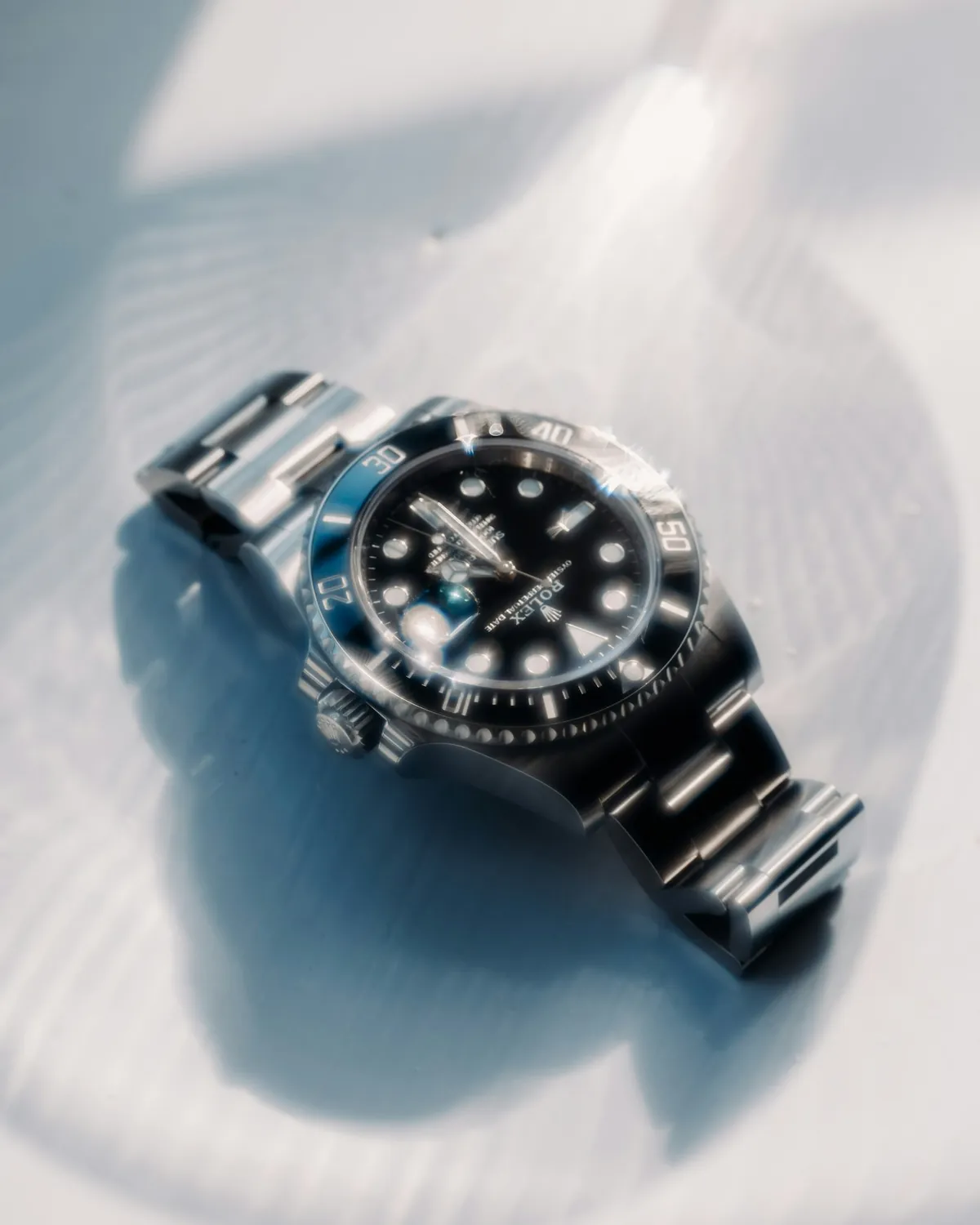
Quick answer
For most wrists and most uses, the Submariner Date 126610LN is the better buy. It is smaller, thinner and the more liquid watch. The Sea-Dweller 126600 makes sense if you have a wrist of 18 cm or more and want a bigger, more serious tool watch. Pre-owned, it often costs less than a Submariner despite a list price about $3,200 higher.
We are independent and do not sell watches. Prices are October 2026 dealer and marketplace levels; MYR figures use 4.08 per US dollar.
Submariner vs Sea-Dweller specifications
On paper the two share a lot: Oystersteel, a black Cerachrom dive bezel, calibre 3235 and a Glidelock clasp. The rows that differ are size, depth rating and price.
| Spec | Submariner Date 126610LN | Sea-Dweller 126600 |
|---|---|---|
| Case diameter | 41 mm | 43 mm |
| Case thickness | 12.5 mm | 15.1 mm |
| Case material | Oystersteel | Oystersteel |
| Bezel | Unidirectional rotatable 60-minute graduated, black Cerachrom insert, numerals and graduations coated in platinum | Unidirectional rotatable 60-minute graduated, black Cerachrom insert, numerals and graduations coated in platinum |
| Dial options | Black | Black ('SEA-DWELLER' in red) |
| Calibre | 3235 | 3235 |
| Power reserve | 70 hours | 70 hours |
| Water resistance | 300 m | 1,220 m |
| Bracelet / strap | Oyster, three-piece solid links; folding Oysterlock safety clasp with Rolex Glidelock extension system | Oyster, three-piece solid links; folding Oysterlock safety clasp with Rolex Glidelock extension system |
| Introduced | 2020 | 2017 |
| Status | Current production | Current production |
| Retail price (US) | US$11,350 | US$14,550 |
| Retail price (Malaysia) | RM49,100 | RM63,000 |
| Pre-owned (excellent, box & papers) | US$14,000 – US$15,600 | US$12,500 – US$15,000 |
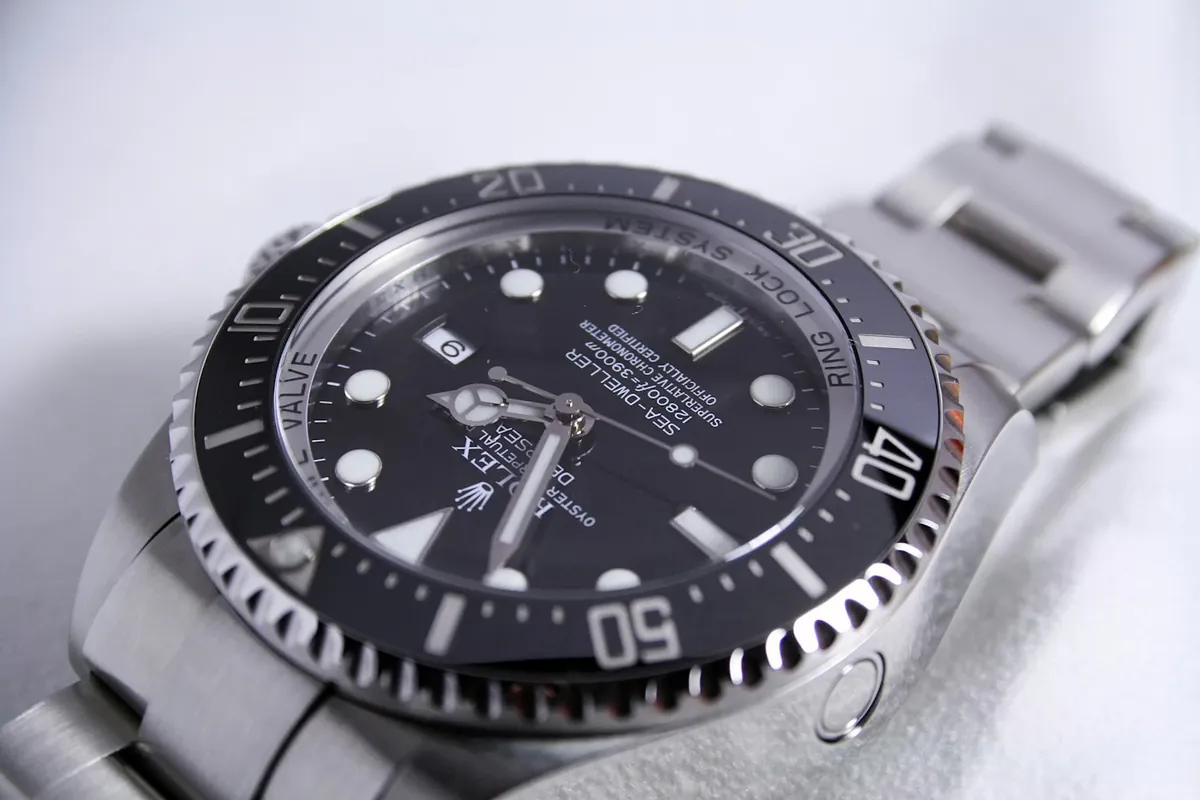
Note what is not in the table. The 126600 has a helium escape valve on its left flank, and its dial prints "SEA-DWELLER" in red with the 1,220 m / 4,000 ft rating. The Submariner lists 300 m / 1,000 ft. Both now have a Cyclops over the date, which on the Sea-Dweller only arrived in 2017.
How the two models diverged
The Submariner came first, in 1953–54, as a 100 m diver's watch for recreational and naval use. By the mid-1960s, however, commercial divers were working far deeper and living in pressurised chambers for days. Rolex answered with the Sea-Dweller in 1967. It was essentially a thicker Submariner with a helium valve and a much higher depth rating.
For decades the two shared a similar 40 mm footprint. The Sea-Dweller was simply taller and had no date magnifier. That changed in 2014, when the 116600 brought ceramic to the Sea-Dweller in a 40 mm case. Three years later, the 126600 grew to 43 mm for the model's 50th anniversary. Meanwhile, the Submariner moved to 41 mm in 2020 but kept its proportions.
As a result, the gap between them is now wider than at any point in their history. Before 2017, choosing a Sea-Dweller meant a slightly thicker Submariner. Today it means a visibly larger watch. That is why wrist size, more than depth rating, decides this comparison for most buyers.
Design and wearability: 41 mm against 43 mm
The numbers that matter on the wrist
Two millimetres of diameter sound minor. However, the real difference is height and length. The Sea-Dweller is 2.6 mm thicker, and its lugs reach about 3 mm further. Together those figures change how the watch sits under a cuff and how it overhangs a slim wrist.
| Measurement | Submariner 126610LN | Sea-Dweller 126600 |
|---|---|---|
| Case diameter | 41 mm | 43 mm |
| Thickness | 12.5 mm | 15.1 mm |
| Lug to lug | about 48 mm | about 51 mm |
| Lug width | 21 mm | about 22 mm |
| Helium escape valve | No | Yes, at 9 o'clock |
| Comfortable on wrists of | about 16.5 cm (6.5 in) and up | about 17.5–18 cm (7 in) and up |
In practice, the Submariner disappears under a shirt cuff. The Sea-Dweller does not, because of its taller case back and thicker crystal. In addition, it is noticeably heavier in steel, which some owners like and others find tiring by evening.
On a 17 cm wrist the 126600's lugs reach the edges of the wrist. By contrast, the Submariner sits inside them. Above roughly 18.5 cm the balance flips, and the Sea-Dweller can look the more proportionate of the two.
Dial, bezel and details
Both dials are black with Chromalight markers. However, the Sea-Dweller's red name line gives it a period flavour that the all-white Submariner text lacks. Also, its bezel is the same 60-minute, 120-click, unidirectional type, only larger, and with a wider grip.
The Cyclops is the detail purists still argue about. Early Sea-Dwellers never had one, because a magnifier is a weak point at extreme depth. Rolex added it in 2017 and the 1,220 m rating stayed intact. Even so, some collectors prefer the earlier 40 mm 116600 for its clean crystal.
Bracelet and clasp
Both use a solid three-piece Oyster bracelet with an Oysterlock clasp and the Glidelock extension. Glidelock slides out in roughly 2 mm steps for about 20 mm in total, without tools. That makes either watch easy to wear over a thin wetsuit or simply on a hot Kuala Lumpur afternoon. The Sea-Dweller's bracelet is wider and heavier to suit the case. Our guide to Rolex bracelets and clasps compares the systems.
Movement and function
Both run calibre 3235 with the Chronergy escapement, a blue Parachrom hairspring and 70 hours of reserve. Both are Superlative Chronometers, regulated to −2/+2 seconds a day after casing. As a result, there is no difference in accuracy, date mechanism or setting.
Water resistance and the helium valve
In short, the real functional difference is the case. The Sea-Dweller is pressure-tested to 1,220 m, four times the Submariner's 300 m. Rolex developed the helium escape valve with professional diving companies in the late 1960s. It vents helium that seeps into the case during long stays in a saturation chamber.
For recreational diving, even deep technical dives, this is unnecessary. Sport divers rarely go below 40 m, and the Submariner's 300 m already leaves huge margin. Therefore the Sea-Dweller's extra capability is about engineering and heritage, not a practical need.
Price comparison: the Sea-Dweller value inversion
This is where the Rolex Submariner vs Sea-Dweller question gets interesting. New, the Sea-Dweller costs more. Used, it often costs less.
| Reference | Retail | Unworn, full set | Excellent, B&P | Good, no papers | Mid-band vs retail |
|---|---|---|---|---|---|
| Submariner 124060 | US$10,050 | US$14,000 – US$15,500 | US$12,800 – US$14,500 | US$11,300 – US$12,500 | +36% |
| Submariner Date 126610LN | US$11,350 | US$15,500 – US$16,900 | US$14,000 – US$15,600 | US$12,300 – US$13,700 | +30% |
| Sea-Dweller 126600 | US$14,550 | US$14,500 – US$16,000 | US$12,500 – US$15,000 | US$11,000 – US$12,500 | -5% |
| Sea-Dweller 126603 | US$22,450 | US$19,500 – US$21,500 | US$17,000 – US$19,500 | US$15,000 – US$16,800 | -19% |
Retail is the current (or last) US list price. Pre-owned bands are rounded market ranges for October 2026; MYR ≈ USD × 4.08.
New prices
At an authorised dealer, the 126610LN lists at US$11,350 (RM49,100 in Malaysia). The 126600 lists at US$14,550 (RM63,000). So a new Sea-Dweller costs RM13,900 more, which buys a heavier case, the valve and a deeper rating.
Pre-owned prices
However, the grey market reverses the order. An excellent 126610LN with papers sits at US$14,000 – US$15,600, roughly RM57,100–63,650. Meanwhile an excellent 126600 sits at US$12,500 – US$15,000, about RM51,000–61,200. In other words, a used Sea-Dweller is usually a few hundred to a thousand dollars cheaper than a used Submariner Date.
The reason is simple: Sea-Dwellers are easier to get at retail, and the size narrows the buyer pool. So the Submariner carries a premium of about 30% over list, while the Sea-Dweller trades around 5% under. For a buyer with a large wrist, that makes a used 126600 one of the better-value steel professional Rolexes in 2026.
Ownership, servicing and resale
Servicing is near identical because the calibre is the same. Rolex suggests roughly ten-year intervals for its current movements, and both carry the five-year international guarantee. The Sea-Dweller's extra parts are the helium valve and its gaskets, which are checked and replaced at service. Our Rolex service and value guide covers what a full service involves.
By contrast, resale is the bigger difference. A 126610LN is the easiest Rolex to sell anywhere, and dealers in Kuala Lumpur or Singapore will quote immediately. A 126600 sells too, but more slowly, and offers will start below list. Consequently, buy the Sea-Dweller to keep, not to flip.
Availability in Malaysia
In our experience, the Sea-Dweller is one of the more attainable steel professional models at Kuala Lumpur authorised dealers. The Submariner Date, by contrast, still involves a wait for most new clients. So if you want a new watch with a fresh card, the Sea-Dweller may be quicker to secure. The retail vs market price guide explains how allocation works.
As always, completeness matters. A dated warranty card, box and all bracelet links add hundreds of dollars on either. See Rolex box and papers for what counts as a full set, and the used Rolex price guide for broader context.
Submariner or Sea-Dweller: which suits you?
Choose the Submariner 126610LN if…
- your wrist is under about 18 cm (7 in)
- you wear a watch under shirt cuffs most days
- you want the most liquid, easiest-to-resell Rolex
- you prefer the lighter, more balanced feel
- you would rather not pay for depth you will not use
Choose the Sea-Dweller 126600 if…
- your wrist is 18 cm or larger and the Submariner looks small
- you like real tool-watch heft and the red dial line
- you want a steel Rolex dive watch trading at or below list
- you can get one from an AD sooner than a Submariner
- you appreciate the helium valve as engineering, if not a need
Verdict
The Submariner is the right watch for most people: it fits more wrists, wears more easily and resells faster. The Sea-Dweller is the smarter purchase for a narrower group, namely buyers with large wrists who want a heavier diver. For them, a used 126600 at around list price is better value than a Submariner Date carrying a 30% premium. Try both on before deciding, because 2.6 mm of extra height changes everything.
Also compare: Submariner vs GMT-Master II, Submariner Date vs No-Date, and the full Sea-Dweller collection.
Submariner vs Sea-Dweller FAQ
Is the Sea-Dweller better than the Submariner?
It is more capable, not better for most people. The Sea-Dweller 126600 is rated to 1,220 m and has a helium escape valve for saturation diving. The Submariner's 300 m is already far beyond recreational scuba limits. Unless you want the larger 43 mm case and red dial text, the Submariner is the more comfortable everyday choice.
Is the Sea-Dweller too big for a small wrist?
Usually, yes, below about 17 cm (6.7 in). The 126600 is 43 mm wide, 15.1 mm thick and about 51 mm lug to lug, so the case can overhang a slim wrist and sits tall under a shirt cuff. Try one on before buying. On wrists of 18 cm and up it looks balanced.
What does the helium escape valve do?
During saturation diving, divers live in pressurised chambers breathing a helium mix. Helium atoms can seep into a watch case. When the chamber decompresses, the trapped gas needs a way out, or it could push the crystal off. The valve at 9 o'clock opens automatically to release it. Recreational divers never need it.
Why does the Sea-Dweller trade below retail when the Submariner trades above?
Demand. The Sea-Dweller is easier to get from authorised dealers, and many buyers find it too large. So the pre-owned market prices it around its US$14,550 list or slightly below. The Submariner is allocated sparingly and has a much bigger buyer pool, so it trades roughly 30% over list.
Why does the Sea-Dweller have a red line?
The single line of red 'SEA-DWELLER' text on the 126600 is a nod to the first Sea-Dweller of 1967, whose early dials printed the name in red. Rolex brought it back for the model's 50th anniversary in 2017, which is why collectors call this reference the 'Single Red'.
Last updated . Written and fact-checked by the Rolex Malaysian editorial team. Specifications and prices are re-checked quarterly.